

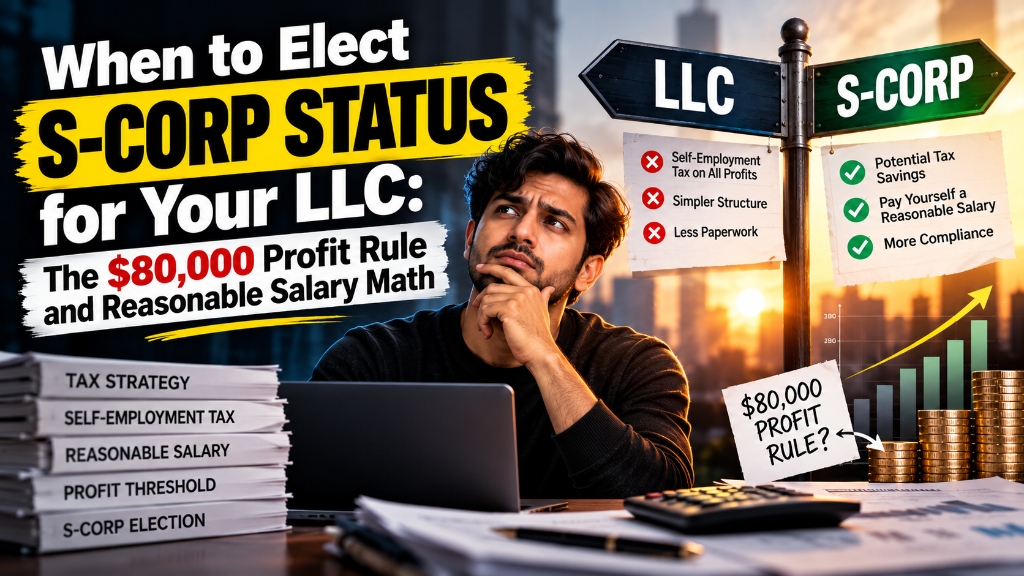
When to Elect S-Corp Status for Your LLC: The $80,000 Profit Rule and Reasonable Salary Math
Discover when to elect S-Corp for single member LLC status. Learn the $80,000 net profit threshold, reasonable salary rules, and Form 2553 filing deadlines.
Educational Resource: This guide does not constitute financial or legal counsel.
Direct Answer: Electing S-Corp status for a single-member LLC becomes mathematically worthwhile when your business generates at least $80,000 to $100,000 in net annual profit after ordinary expenses. At this threshold, your savings on federal self-employment taxes (15.3% on non-wage shareholder distributions) comfortably surpass the $2,000 to $4,000 in additional administrative costs for payroll services, tax prep, and state corporate fees.
Social media tax influencers love to preach that every entrepreneur should form an S-Corporation on day one. They flash graphics promising thousands of dollars in eliminated self-employment taxes, urging brand-new freelancers, agency founders, and consultants to file paperwork immediately.
What these gurus fail to disclose is the expensive operational drag of corporate compliance.
Knowing when to elect s corp for single member llc operations requires understanding the friction points: running formal monthly payroll, purchasing payroll software, paying federal and state unemployment taxes, filing a separate Form 1120-S corporate return, and navigating strict IRS scrutiny regarding shareholder salaries. If your annual net profit is under $60,000, electing S-Corp status will often cost you more in professional fees and administrative overhead than you will ever save in taxes.
However, once your net business income crosses roughly $80,000, the mathematical dynamic flips in your favor.
Here is the realistic, unvarnished guide to S-Corp taxation, the exact calculations behind the $80,000 threshold, how to determine an IRS-compliant reasonable salary, and how to execute the election cleanly.
S-Corp Election Tipping Points: Real Math Behind the $80,000 Threshold
The $80,000 net profit threshold represents the break-even point where self-employment tax reductions reliably exceed the annual administrative costs of running an S-Corporation.
As a default single-member LLC, the IRS treats your business as a “disregarded entity” for tax purposes. Every single dollar of net profit flows onto Schedule C of your personal Form 1040, where it is subjected to two distinct taxes: ordinary income tax and the 15.3% federal self-employment tax (12.4% Social Security up to the annual wage cap, plus 2.9% Medicare with zero income cap).
- Default Single-Member LLC: 100% of net profit is subject to 15.3% self-employment tax.
- S-Corporation Structure: W-2 salary is subject to 15.3% FICA, while remaining profit is distributed as 0% FICA shareholder distributions.
When you elect S-Corp status by filing IRS Form 2553, you split your earnings into two distinct categories:
- W-2 Shareholder-Employee Salary: Subject to standard payroll withholding (15.3% FICA taxes plus ordinary income tax).
- Shareholder Profit Distributions: Free from the 15.3% self-employment tax, though still subject to ordinary income tax.
The tax savings exist entirely within the distribution portion. If your business nets $50,000 and you must pay yourself a realistic W-2 salary of $40,000, you only shield $10,000 from FICA taxes: saving roughly $1,530. If your new CPA filing fees, payroll software (such as Gusto), and state franchise taxes total $2,500, you have actually lost nearly $1,000 in cash by electing S-Corp status.
How S-Corp Taxation Works: The Pass-Through Self-Employment Tax Shield
An S-Corporation shields profits by dividing business net income into payroll wages and non-wage owner dividends, legally avoiding FICA taxes on the dividend portion.
To understand why this strategy works, consider how the federal government treats business owners who perform services. Under the Internal Revenue Code, sole proprietors are classified as self-employed individuals whose entire net income represents compensation for labor.
Under an S-Corporation framework, your corporate entity legally hires you as an employee. As an employee, you receive a standard paycheck with federal and state taxes withheld. However, as the 100% equity shareholder, any profits left over after paying all business expenses and your reasonable salary belong to you as return on capital investment.
The IRS does not levy FICA payroll taxes on shareholder equity distributions. By legally categorizing 30% to 50% of your business net profit as distributions rather than labor wages, you legally avoid paying the 15.3% tax on that portion of your revenue.
The Hidden Overhead: Payroll Fees, Unemployment Insurance, and Form 1120-S Filings
Running an S-Corporation introduces mandatory recurring overhead that can quickly erode tax savings if your profit margin is too thin.
Before filing Form 2553, you must account for the real-world operational costs required to maintain corporate compliance:
| Administrative Expense Item | Typical Annual Cost | Description & Compliance Requirement |
|---|---|---|
| Form 1120-S Corporate Tax Return | $1,200 to $2,500 | Professional CPA preparation for annual corporate federal and state returns |
| Payroll Processing Platform | $500 to $900 | Automated payroll software (e.g., Gusto, QuickBooks) to calculate tax withholdings |
| Federal & State Unemployment Taxes (FUTA/SUTA) | $400 to $800 | Mandatory employer unemployment taxes levied on your own W-2 wages |
| State Corporate Franchise Taxes / Annual Fees | $0 to $800+ | Annual minimum state franchise fees (e.g., California imposes an $800 minimum annual tax) |
| Bookkeeping and Reconciliation | $1,200 to $2,400 | Rigorous balance sheet maintenance required for corporate tax preparation |
In total, operating an S-Corporation introduces between $2,500 and $4,500 in baseline annual overhead. If your estimated FICA tax savings do not significantly exceed this overhead figure, the conversion adds operational complexity without financial benefit.
Real-World Scenarios: Net Tax Savings at $60,000, $100,000, and $200,000 Profit Tiers
Evaluating S-Corp suitability across concrete profit tiers proves that net benefits scale aggressively only once net business income approaches six figures.
Let’s analyze three hypothetical solo business owners operating in a state with modest franchise taxes, assuming baseline annual S-Corp administrative costs of $3,000:
Scenario 1: $60,000 Annual Net Profit
- Reasonable Salary: $42,000 W-2 wages (70% allocation)
- Shareholder Distribution: $18,000
- FICA Tax Savings (15.3% on $18k): ~$2,754
- Minus S-Corp Compliance Overhead: -$3,000
- Net Annual Result: -$246 Net Loss. (The owner works harder on administrative paperwork and ends up with less cash in their pocket).
Scenario 2: $100,000 Annual Net Profit
- Reasonable Salary: $60,000 W-2 wages (60% allocation)
- Shareholder Distribution: $40,000
- FICA Tax Savings (15.3% on $40k): ~$6,120
- Minus S-Corp Compliance Overhead: -$3,000
- Net Annual Result: +$3,120 Net Tax Savings. (The S-Corp election clearly justifies the administrative setup).
Scenario 3: $200,000 Annual Net Profit
- Reasonable Salary: $100,000 W-2 wages (50% allocation)
- Shareholder Distribution: $100,000
- FICA Tax Savings: ~$13,500 (accounting for the Social Security wage cap ceiling)
- Minus S-Corp Compliance Overhead: -$3,000
- Net Annual Result: +$10,500+ Net Tax Savings. (Substantial, game-changing cash retention for the business owner).
Estimated Net Annual Benefit = (Projected Shareholder Distributions * 15.3%) - Estimated Annual Corporate Overhead ($3,500)
If the resulting number is less than $2,000, remain a standard single-member LLC for the current tax year.
IRS “Reasonable Compensation” Rules: How to Avoid Red Flags on Form W-2
IRS reasonable compensation rules require shareholder-employees to pay themselves a fair market wage commensurate with the services they deliver before taking any profit distributions.
The most dangerous mistake single-member S-Corp owners make is setting an artificially tiny W-2 salary to maximize tax-free distributions. Some owners draw a $15,000 salary while taking $150,000 in dividends.
The IRS is acutely aware of this loophole. In fact, aggressive distribution-to-salary ratios represent the number-one audit trigger for small S-Corporations. If the IRS audits your business and rules that your salary was unreasonably low, they will reclassify your distributions as wages, charge back-payroll taxes for all prior years, and assess punitive penalties with compounding interest.
Factors the IRS Uses to Determine “Reasonable Salary”
- Training and Experience: What would an independent third-party company pay someone with your years of specialized skill?
- Duties Performed: Are you functioning as the chief executive, head of sales, customer support agent, and lead technician all at once?
- Time and Effort Devoted: Are you working 10 hours a week or 55 hours a week?
- Comparable Market Wages: What do salary aggregators (Bureau of Labor Statistics, Glassdoor, Payscale) report for comparable job roles in your geographic region?
To defend your salary during an audit, never rely on arbitrary “60/40 rules” found on internet forums. Document your methodology by obtaining a formal Reasonable Compensation Report from a tax advisory platform or CPA. Having an objective, data-backed study in your files shifts the burden of proof back onto the IRS.
Deadlines and Late-Relief Protocols: Filing IRS Form 2553 Under Rev. Proc. 2013-30
To elect S-Corp taxation for the current year, you must submit IRS Form 2553 within two months and 15 days of the start of your tax year, or seek retroactive late election relief.
For calendar-year taxpayers operating on a January 1 to December 31 fiscal schedule, the hard deadline to file Form 2553 is March 15 of the tax year in which you want the election to take effect. If you form a brand new LLC midway through the year, you have exactly 75 days from the date of formation to file.
- On-Time Filing Timeline: Tax Year Begins (Jan 1) ➔ File Form 2553 by March 15 (75 Days) ➔ Valid Current-Year Election.
- Late Relief Protocol: Missed March 15 Deadline ➔ Apply for Retroactive Relief under IRS Revenue Procedure 2013-30.
What If You Missed the March 15 Deadline?
If you missed the standard deadline, do not panic. The IRS recognizes that small business owners frequently miss technical filing dates. Under IRS Revenue Procedure 2013-30, you can request retroactive S-Corp status up to three years and 75 days after the intended effective date.
To qualify for late election relief, you must meet four conditions:
- The company qualified as an S-Corporation on the date the election was intended to take effect.
- The company intended to be classified as an S-Corporation as of that date.
- The failure to file Form 2553 on time was solely due to reasonable cause (e.g., relying on tax advice or lack of familiarity with election procedures).
- All shareholders reported their taxes consistently with S-Corp status on their personal tax returns.
You request this relief by writing: “FILED PURSUANT TO REV. PROC. 2013-30” directly across the top margin of Form 2553 and attaching a statement explaining your reasonable cause.
Decision Checklist: Should You Convert for the Upcoming Tax Year?
Review this 5-point practical audit to decide if converting your single-member LLC to an S-Corp makes sense for the upcoming tax cycle:
- Consistent Profitability: Has your business reliably generated at least $80,000 in net profit for the past 12 months, and do you expect revenue to remain steady or grow?
- Predictable Cash Reserves: Does your business maintain at least 3 months of operating expenses in cash to comfortably fund regular monthly W-2 payroll?
- Qualified Professional Support: Do you have a trusted CPA or tax professional willing to prepare your annual Form 1120-S corporate return and balance sheet?
- Disciplined Bookkeeping: Are your business accounts strictly segregated from personal expenses, with clean monthly bookkeeping reconciled in accounting software?
- Tolerance for Administrative Routine: Are you comfortable filing quarterly 941 reports, managing state withholding accounts, and issuing yourself a Form W-2 every January?
Frequently Asked Questions
Is an S-Corp worth it at $100k net profit?
Yes, an S-Corp is almost always worth it at $100,000 net profit because you can typically save between $3,000 and $4,500 in net self-employment taxes even after subtracting all payroll software, CPA filing fees, and corporate compliance costs.
Can a single-member LLC elect S-Corp status without creating a new legal entity?
Yes, a single-member LLC does not need to reform or dissolve its legal entity; you simply file IRS Form 2553 to change how your existing LLC is taxed at the federal level.
Does an S-Corp reduce income tax or only self-employment tax?
An S-Corp election specifically reduces self-employment taxes (FICA); it has zero direct impact on federal or state ordinary income tax rates because all net business profits pass through to your personal tax return regardless.
What happens if I pay myself zero salary in an S-Corp?
Paying yourself zero salary while distributing corporate profits is illegal under IRS rules, and doing so will almost certainly trigger an audit, result in the reclassification of all distributions as wages, and incur severe back taxes and penalties.
Can I contribute to a Solo 401(k) with an S-Corp?
Yes, you can contribute to a Solo 401(k) under an S-Corp, but your employee deferrals and employer non-elective contributions are calculated solely on your W-2 salary, not your shareholder distributions.
Final Thoughts: Treat Entity Structuring as an ROI Decision
Electing S-Corp status is not a badge of entrepreneurial honor: it is a straightforward financial calculation.
When your net profit is modest, staying a default single-member LLC keeps your administrative burdens low, frees you from payroll obligations, and lets you focus 100% of your energy on acquiring customers and building cash flow.
Once your business consistently nets $80,000 or more per year, schedule a meeting with a qualified CPA. Calculate your reasonable salary using verifiable market wage data, run an s corp tax savings calculator 2026 simulation against your actual overhead, and make the election with complete confidence.
Download: The Solo Founder's High-Margin Scaling Playbook
A battle-tested blueprint on building asymmetric leverage, packaging high-ticket B2B services, and converting labor into scalable digital products.
- Pricing power & contract negotiation scripts
- Micro-SaaS & digital product launch checklist
This article and its associated calculators are for educational and informational purposes only and do not constitute financial, investment, legal, tax, or medical advice. We may earn an affiliate commission on third-party links at zero cost to you. Always consult a licensed professional before making major financial, health, or investment decisions. Read our full Legal & Financial Disclaimer.
Vikram Nair
Verified AuthorVikram covers small business ideas, digital ventures, and practical company growth. Having worked alongside early-stage founders, he writes straightforward advice on building profitable businesses.
Was this essay valuable to you?
Help us refine our editorial focus and research priorities.
Reader Discussion (2)
Extremely well-articulated analysis on capital compounding. The breakdown on equity allocation vs active income is spot on.
The distinction between looking rich and building real moats is something more founders need to study deeply.
Explore Eternity Empire
Search empirical insights, explore our four wisdom categories, and discover curated strategic essays.
Search Insights
Recent Essays
The Backyard Cash Flow Engine: How to House Hack with an ADU in 2026
11 min read • Oct 20How to Become a Fractional COO: Landing Your First $5,000/Month Retainer Client
12 min read • Oct 20The Zero-Bounce Outbound Engine: How to Set Up Multi-Domain Cold Email with Instantly and Clay
12 min read • Oct 20Featured Guides
Further Wisdom & Insights
Explore All Articles
Automated Bookkeeping for Solopreneurs: Build a Zero-Touch Stack
Build an automated bookkeeping stack for your solo business. Connect Stripe, bank feeds, OCR receipts, and ledgers to save 10+ hours monthly.
Solo 401(k) vs. SEP IRA in 2026: Contribution Limits and Tax Math
Compare Solo 401(k) vs SEP IRA in 2026. Calculate exact contribution limits, tax deductions, and Roth options across $80k, $150k, and $250k profit tiers.
Beyond Zapier: 7 Self-Hosted n8n Workflows to Automate Your Business on a $5 VPS
Cut hundreds in SaaS subscription fees by migrating to self-hosted n8n. Discover 7 automated workflows for lead qualification, onboarding, and CRM sync.