

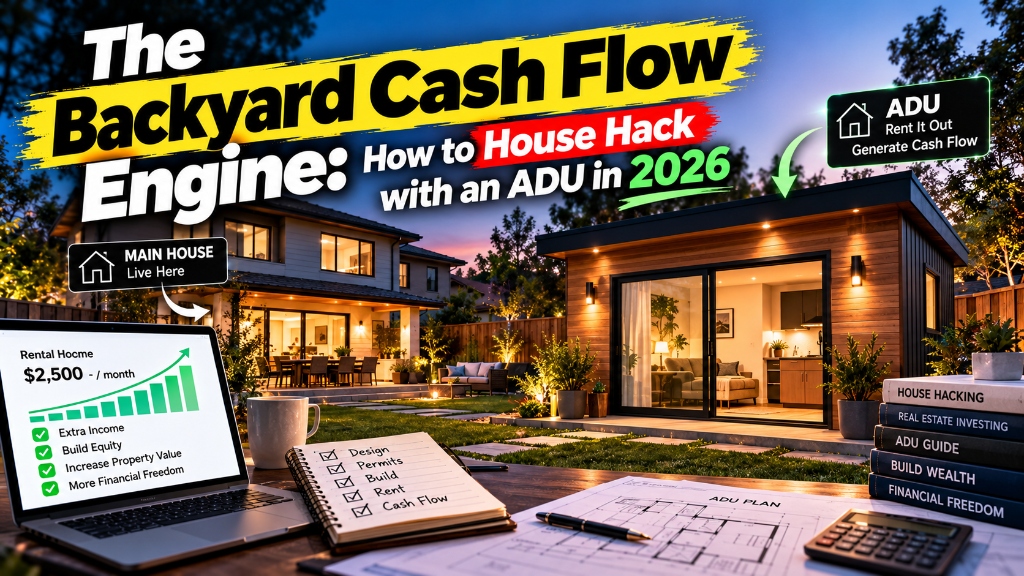
The Backyard Cash Flow Engine: How to House Hack with an ADU in 2026
Master the ADU house hacking strategy. Learn how building a backyard accessory dwelling unit can offset 70% to 100% of your primary mortgage payment.
Educational Resource: This guide does not constitute financial or legal counsel.
Direct Answer: An ADU house hacking strategy involves constructing a detached or attached accessory dwelling unit (such as a backyard cottage or converted garage) on your single-family property to generate recurring rental income. By renting the secondary unit to long-term or mid-term tenants, homeowners can generate $1,500 to $3,000 monthly, offsetting 60% to 100% of their primary mortgage payment.
Traditional real estate investing advice often feels impossibly out of reach for modern homeowners.
With median home prices lingering at historical highs and mortgage rates remaining elevated, buying a standalone single-family rental property or duplex requires saving $80,000 to $120,000 in liquid capital for a 25% down payment and closing costs. For the average family, accumulating that much idle cash takes years of extreme sacrifice.
Meanwhile, an untapped real estate goldmine is sitting completely unused right outside your back window: your backyard.
Deploying an adu house hacking strategy is one of the most effective, accessible wealth-building hacks available today. Thanks to sweeping nationwide zoning legislation, millions of suburban homeowners can now legally build an Accessory Dwelling Unit (ADU) on their single-family lots by right.
Instead of purchasing an expensive second property in an unfamiliar neighborhood, you build high-yield rental square footage on land you already own. By leveraging modern construction loans or prefabricated modular units, your secondary suite can generate immediate positive cash flow, effectively subsidizing or completely wiping out your primary housing expense.
Here is the complete blueprint to zoning rules, construction economics, smart financing options, and tenant management to transform your backyard into an automated cash flow engine.
The Zoning Revolution: Why Building on Single-Family Lots Is Easier Than Ever
Recent legislative zoning reforms have eliminated local discretionary review, granting single-family homeowners the statutory right to build accessory dwelling units on residential lots.
For decades, local municipal zoning codes made building a secondary rental unit virtually impossible. Homeowners faced aggressive NIMBY (“Not In My Backyard”) opposition, restrictive parking minimums, expensive setback mandates, and lengthy discretionary city council hearings designed to block new housing.
- Historic Municipal Bureaucracy: Discretionary Review ➔ Parking Mandates ➔ Neighbors Block Permit (Dead End).
- Modern ADU Legislation: Permitted By Right ➔ Ministerial Approval ➔ Mandatory 60-Day Permit Mandate (Streamlined Construction).
Led by landmark legislation in California (SB 9 and AB 68), and quickly followed by states like Washington, Oregon, Colorado, and Florida, the legal landscape has fundamentally changed:
- Ministerial Permitting By Right: Cities are legally required to review ADU applications ministerially (meaning if the design meets objective building codes, the city cannot deny the permit based on subjective neighbor objections).
- Mandatory 60-Day Approval Timelines: Municipalities must approve or deny complete ADU building permit applications within 60 days of submission.
- Elimination of Parking Requirements: If your home is located within a half-mile of public transit, most state laws forbid cities from requiring you to add replacement off-street parking spaces.
- HOA Restriction Bans: State statutes now void any Homeowners Association (HOA) covenants that attempt to ban or prohibit the construction of accessory dwelling units.
These reforms mean you no longer need political influence or years of rezoning battles to develop rental housing on your parcel.
ADU Economics: Prefab Modular Units vs. Traditional Stick-Built Additions
Choosing between prefabricated modular units and traditional on-site stick-built construction dictates your upfront capital expenditure, timeline to occupancy, and rental yield.
When planning an ADU, homeowners generally face a fundamental choice between factory-built modular construction and custom on-site framing:
| Construction Methodology | Average Cost per Sq. Ft. | Construction Timeline | Primary Advantage | Main Drawback |
|---|---|---|---|---|
| Prefabricated Modular ADU (e.g., Abodu, Villa, Mighty Buildings) | $275 to $400 / sq. ft. ($140k–$240k total) | 3 to 5 months total (factory build + 4 weeks on site) | Fixed pricing, fast installation, minimal backyard disruption | Limited architectural customization; crane access required |
| Traditional Stick-Built Custom ADU | $350 to $550+ / sq. ft. ($180k–$320k total) | 8 to 14 months total | 100% custom floor plans to fit odd lot shapes | Risk of contractor delays, change-order cost overruns, extended construction noise |
| Garage Conversion (JADU / Junior ADU) | $150 to $250 / sq. ft. ($70k–$130k total) | 2 to 4 months total | Lowest capital cost; utilizes existing foundation and roof | Sacrifices covered vehicle parking and garage storage space |
For most suburban lots with clear side-yard or crane access, prefabricated modular units represent the optimal return on investment. The unit is framed, plumbed, and wired inside a climate-controlled factory while your local contractor pours the concrete foundation in your yard.
Once the foundation cures, a crane drops the modular unit into place in a single afternoon, allowing you to welcome a paying tenant months ahead of traditional construction schedules.
Financing Options: Renovation Loans, FHA Guidelines, and Construction HELOCs
Financing an ADU build requires leveraging your existing home equity, applying for specialized renovation mortgages, or utilizing updated FHA lending rules that count future rental income.
Funding a $150,000 to $200,000 construction project does not require liquidating your retirement savings. Lenders offer several structured debt mechanisms tailored to ADU development:
1. Home Equity Line of Credit (HELOC) or Fixed-Rate Home Equity Loan
If you purchased your home years ago and have built significant equity, a second-lien HELOC is the fastest, lowest-cost financing method. You borrow against your accrued equity at competitive rates, draw funds incrementally as contractor invoices come due, and pay interest only on the capital deployed during construction.
2. Fannie Mae HomeStyle and Freddie Mac CHOICERenovation Loans
These conventional renovation loans allow you to refinance your existing mortgage based on the projected future appraised value of your home after the ADU is completed. This allows homeowners who have modest current equity to borrow up to 75% to 80% of the home’s anticipated post-construction market value.
Under updated Federal Housing Administration (FHA) guidelines, mortgage lenders are now permitted to count up to 75% of projected future rental income from an unbuilt ADU to help a borrower qualify for an FHA purchase or renovation mortgage. This makes qualifying for construction financing significantly easier for first-time buyers.
3. Specialized Modular ADU Financing Partners
Many modern prefab builders partner directly with specialized construction fintech lenders (such as RenoFi or CrossCountry Mortgage) that offer integrated construction-to-permanent loans with zero personal cash out of pocket.
Permitting and Utility Hookups: Navigating Municipal Red Tape
Navigating the ADU permitting process smoothly requires early utility capacity audits and adherence to local setback standards.
Even with favorable state laws, local building codes demand rigorous compliance in two specific areas:
1. Utility Infrastructure (Sewer, Water, Electrical)
Before finalizing architectural plans, hire an electrician and plumber to audit your main utility connections:
- Electrical Panel Capacity: Most 1970s and 1980s homes have 100-amp electrical panels. Powering a separate living unit with mini-split HVAC, electric water heating, and cooking appliances usually requires upgrading your main service panel to 200 amps.
- Sewer Lateral Connections: You must determine whether your municipality permits the ADU to tie into your home’s existing sewer lateral or mandates a separate dedicated street connection (which can add $10,000 to $20,000 in trenching costs).
2. Standardized Dimensional Setbacks
Under most modern zoning codes, detached backyard ADUs must adhere to standardized dimensional constraints:
- Maximum height limit: Typically 16 to 18 feet for single-story structures.
- Rear and side setbacks: Standardized to 4 feet from property lot lines in most reformed states.
- Square footage limits: Typically capped at 800 to 1,200 square feet for two-bedroom units, or up to 500 square feet for Junior ADUs (JADUs).
Rental Models: Long-Term Tenants vs. Mid-Term Traveling Healthcare Professionals
Selecting between long-term leases and 30-to-90 day furnished mid-term rentals balances recurring revenue against tenant privacy and management overhead.
Because the rental unit sits directly in your backyard, tenant screening and rental strategy require careful personal consideration:
| Rental Strategy | Target Guest / Tenant Profile | Typical Monthly Revenue | Management Overhead | Privacy Level for Homeowner |
|---|---|---|---|---|
| Long-Term Unfurnished (12-Month Lease) | Young professionals, graduate students, couples | $1,600 to $2,400/month | Very low (1 inspection per year; automated rent collection) | Moderate (tenant shares driveway and yard space year-round) |
| Mid-Term Furnished (30 to 90 Days) | Traveling nurses, corporate relocations, insurance displacement | $2,400 to $3,500/month (+30% to 50% premium) | Moderate (turnovers 4 to 6 times per year; fully furnished) | High (tenants work long shifts, travel frequently, stay temporarily) |
| Short-Term Vacation Rental (Airbnb) | Weekend tourists, family visitors | Highly volatile ($2,000 to $4,500/mo) | High (constant cleaning, guest messaging, check-ins) | Low (strangers constantly walking through property; subject to local ban) |
For most backyard house hackers, the mid-term rental model (marketed via platforms like Furnished Finder or corporate housing sites) offers the ultimate sweet spot. Traveling healthcare professionals and remote corporate transferees are vetted, have steady income, work demanding schedules, and rarely spend leisure time in your backyard: while paying a substantial premium over traditional 12-month unfurnished leases.
ADU Cash Flow Calculator and Return-on-Investment Worksheet
Evaluating an ADU build as an investment requires calculating the net monthly spread between new financing costs and realistic rental income.
Let’s model the real-world finances of constructing a 600 sq. ft. 1-bedroom prefab ADU in a mid-cost suburban market:
Net Cash Flow = Monthly Gross Rental Income - (Monthly ADU Financing Payment + Insurance + Maintenance Reserve)
Example: $2,300 rent - ($1,250 loan payment + $75 insurance + $100 maintenance) = +$875 Net Monthly Cash Flow.
Detailed Pro-Forma Investment Breakdown:
- Total Project Cost (Turnkey Prefab + Permits + Utilities): $175,000
- Financing: $175,000 HELOC or fixed home equity loan at 7.0% amortized over 20 years
- Monthly Debt Service (Principal & Interest): $1,356/month
- Additional Property Taxes & Insurance Adjustment: $120/month
- Monthly Maintenance & Vacancy Reserve (8%): $180/month
- Total Monthly Carrying Cost: $1,656/month
Revenue Scenarios:
- Long-Term Rental Model: Units rent for $2,100/month.
- Net Profit: +$444/month in pure cash flow.
- Mid-Term Traveling Healthcare Model: Furnished units rent for $2,750/month.
- Net Profit: +$1,094/month in pure cash flow.
In both scenarios, the tenant completely pays for the construction loan, covers increased property taxes, and generates hundreds of dollars in surplus cash flow that directly subsidizes your primary mortgage: all while building hundreds of thousands in permanent equity value for your primary estate.
Frequently Asked Questions
Can ADU rental income cover my entire primary mortgage payment?
Yes, in high-cost-of-living coastal markets or when operating as a furnished mid-term rental, a well-designed 2-bedroom ADU generating $2,500 to $3,500 monthly can easily offset 70% to 100% of an existing low-interest primary mortgage payment.
How much does an accessory dwelling unit add to property value?
Appraisal data shows that an ADU typically increases overall residential property value by roughly 70% to 100% of the total construction cost, or between 20% and 35% of the existing home’s market value.
Do I need a separate address for my backyard ADU?
Yes, cities typically assign a distinct secondary mailing address (such as “Unit B” or “1/2”) to permitted ADUs to enable dedicated mail delivery, separate emergency 911 dispatch, and independent utility meter billing.
Can an HOA prevent me from building an ADU?
In states with modernized ADU legislation (such as California, Oregon, and Washington), statutory laws explicitly override private Homeowners Association covenants, making it illegal for an HOA to unreasonably prohibit or delay ADU construction.
What is the cheapest way to build an ADU?
The most cost-effective method is converting an existing attached garage or basement into a Junior Accessory Dwelling Unit (JADU), which typically costs between $60,000 and $110,000 because the foundation, framing, and roof are already structurally sound.
Final Thoughts: The Future of Suburban Housing Wealth
The traditional American single-family suburban home was designed as a pure consumption asset that drained monthly cash flow through maintenance, property taxes, and mortgage interest.
By embracing an adu house hacking strategy, you flip that dynamic on its head. You transform a passive lawn into an income-producing asset, contribute much-needed housing density to your local community, and build a resilient multi-generational wealth engine.
Walk into your backyard this afternoon. Measure your lot boundaries, check your municipal zoning guidelines online, and consult with local modular builders to see how quickly you can turn empty square footage into recurring monthly freedom.
Download: The 2026 Wealth Compounding & FIRE Planning Toolkit
Our complete spreadsheet model and 28-page strategic handbook covering asset allocation buckets, Indian inflation adjustments, and long-term SIP compounding.
- Interactive FIRE & Net Worth Excel/Sheets model
- Asset allocation & emergency reserve matrix
This article and its associated calculators are for educational and informational purposes only and do not constitute financial, investment, legal, tax, or medical advice. We may earn an affiliate commission on third-party links at zero cost to you. Always consult a licensed professional before making major financial, health, or investment decisions. Read our full Legal & Financial Disclaimer.
Aditya Singhania
Verified AuthorAditya writes about investing, saving habits, and smart money management. With a background in financial planning, he helps readers build simple, reliable wealth habits for the long run.
Was this essay valuable to you?
Help us refine our editorial focus and research priorities.
Reader Discussion (2)
Extremely well-articulated analysis on capital compounding. The breakdown on equity allocation vs active income is spot on.
The distinction between looking rich and building real moats is something more founders need to study deeply.
Explore Eternity Empire
Search empirical insights, explore our four wisdom categories, and discover curated strategic essays.
Search Insights
Recent Essays
How to Become a Fractional COO: Landing Your First $5,000/Month Retainer Client
12 min read • Oct 20The Zero-Bounce Outbound Engine: How to Set Up Multi-Domain Cold Email with Instantly and Clay
12 min read • Oct 20The Frugality Ceiling: Why Cutting Lattes Caps Out and How to Shift to an Earning Expansion Mindset
11 min read • Oct 20Featured Guides
Further Wisdom & Insights
Explore All Articles
How to Make Passive Income in India in 2026: 10 Realistic Ways to Start
Discover 10 realistic passive income ideas in India for 2026. Compare capital requirements, upfront effort, tax implications, and expected returns.
Mortgage Recast vs. Refinance: How to Cut Your Monthly House Payment Without Losing Your Low Rate
Compare mortgage recast vs refinance calculator math. Learn how to lower monthly house payments for $300 without giving up your 3% fixed mortgage interest rate.

Index Fund Investing for Beginners: The 3-Fund Portfolio (2026)
Master index fund investing with the simple 3-fund portfolio in 2026. Learn exact Vanguard, Fidelity, and Schwab tickers, age allocations, and tax placement.