

Tesla Roadster Flying Car: Inside the Thruster Physics, the 0.59s Claim, and Street Legality
The tesla roadster flying car hopped a fleet and drove upside down. See how the thrusters work, the 0.59s claim, and whether it’s street legal.
Educational Resource: This guide does not constitute financial or legal counsel.
The Tesla Roadster flying car combines high-pressure SpaceX cold-gas thrusters with underbody ground-effect fans to hop over vehicles, drive upside down on curved surfaces, and post a claimed sub-0.59s 0-60 mph sprint. While the road-ready Performance trim approaches production, the thruster-equipped Rocket tier faces major regulatory and airspace hurdles before achieving street legality.
Elon Musk said it plainly on stage: “Flying cars are real.” Then I watched the clip again and noticed how short the “flying” part actually is.
That gap is what this analysis is about. The tesla roadster flying car is a real machine executing physical maneuvers no production automobile has ever achieved. At the same time, it is fundamentally different from what the popular phrase “flying car” conjures in the public imagination. Let us separate the physics, engineering, and regulatory realities from the stage performance.
Breaking Down the McGregor Demo: Inverted Walls, Mid-Air Flips, and the Fleet Jump
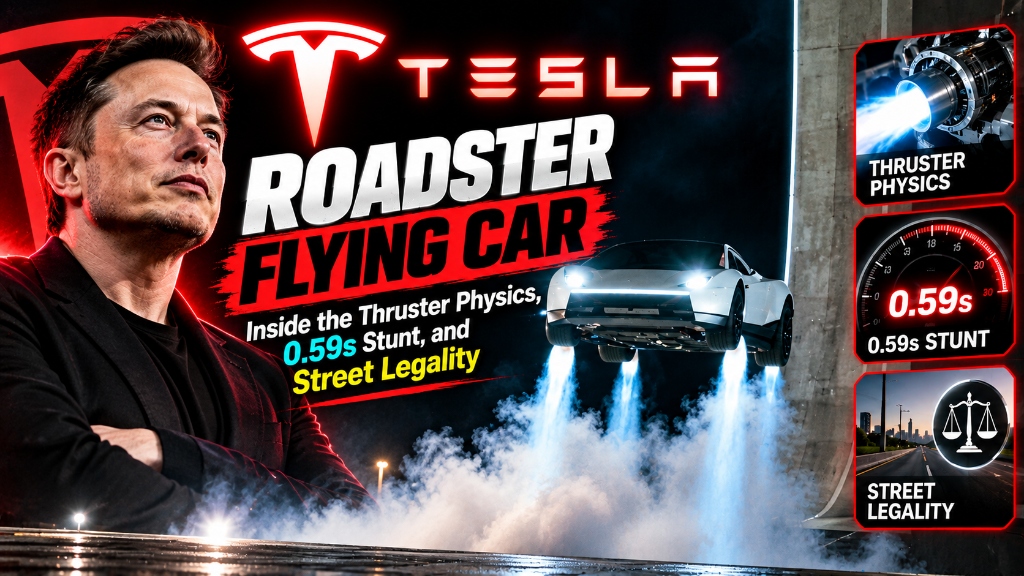
The McGregor flight demonstration showed the prototype car driving up a curved track until upside down, performing a controlled mid-air flip, and hopping across a lineup of five production vehicles.
Tesla demonstrated the vehicle powering up a curved ramp until it reached an inverted orientation. It then launched off the lip, executed a mid-air rotation, and settled onto the tarmac below. Musk’s immediate reaction on stage was straightforward: “Well, it worked.”
On-screen telemetry captured during the event indicated a pitch angle of 170 degrees at an elevation roughly 21 metres off the ground. That represents an almost fully inverted attitude at the equivalent height of a seven-story building.
| Flight Demonstration Phase | Maneuver Details | Physical Metrics |
|---|---|---|
| 1. Inverted Wall Climb | Vertical wall ascent under cold-gas propulsion | 170° Pitch angle |
| 2. Mid-Air Roll & Flip | Cold-gas thruster pulse initiating aerial rotation | 21-meter apex elevation |
| 3. Fleet Obstacle Clearance | Leap cleared across Cybercab, Semi, and Cybertruck | 5-vehicle aerial traverse |
| 4. Pneumatic Touchdown | Active suspension dampens descent to zero bounce | 4-corner balanced landing |
The second act consisted of the fleet jump. The Roadster levitated across a line of Tesla vehicles: hovering over a Cybercab, Cybertruck, Tesla Semi, Model Y, and Model 3 while sustaining forward momentum.
One crucial detail governs this entire stunt. Musk confirmed that the car operated in an autonomous mode during the demo “to make sure we don’t kill anyone.” A human pilot was not at the helm. That distinction matters significantly when imagining everyday consumers attempting similar maneuvers on a Tuesday afternoon.
How It “Flies”: SpaceX Cold-Gas Thrusters vs. Ground-Effect Fan Suction
The Tesla Roadster achieves its aerial maneuvers through two distinct mechanisms: underbody suction fans that pin it to inverted surfaces and SpaceX cold-gas thrusters that deliver momentary upward and lateral bursts.
These are two entirely separate systems serving two distinct physical tasks, though public commentary frequently confuses them:
- Underbody Ground-Effect Fans (Inverted Adhesion): The fans handle the ceiling and wall runs. Musk noted that the underbody fan system can generate up to two Gs of downforce. Positioned within the rear diffuser, the setup mirrors the historic 1978 Brabham BT46B “fan car” design, expelling air from beneath the floorpan to generate an intense low-pressure vacuum. Tesla claims this suction generates sufficient negative lift to anchor the vehicle upside down even while completely stationary. Crucially, this is a ground-effect phenomenon; it requires an adjacent boundary surface to generate pressure differentials and cannot lift the car into free air.
- SpaceX Cold-Gas Thrusters (Airborne Bursts): The thrusters handle the actual jump. A cold-gas thruster is the simplest form of rocket engine: no combustion, no chemical propellants, and no open flames. Highly compressed gas stored in composite-overwrapped pressure vessels (COPVs) is rapidly vented through supersonic convergent-divergent de Laval nozzles. As gas exits at high velocity, momentum conservation imparts equal and opposite thrust to the chassis. During the demonstration, downward-facing thrusters mounted at all four corners fired in unison to arrest descent and stabilize the landing.
| Propulsion Subsystem | Hardware Architecture | Operational Capabilities |
|---|---|---|
| High-Pressure Storage | SpaceX Composite Overwrapped Pressure Vessels (COPV) | Ultra-dense compressed air fuel reservoir |
| Perimeter Thrusters | Multi-directional cold-gas rocket nozzles | Vertical lift, rapid acceleration, pitch/yaw stability |
| Underbody Fan Diffuser | High-vacuum ground-effect fan assembly | Up to 2.0 Gs downward suction and surface adhesion |
The fundamental physics determines how far this airborne capability can extend. To lift off, total thrust must exceed gravitational force ($T > mg$). For an electric sports car weighing approximately two tonnes (2,000 kg), the system requires at least 19.6 kilonewtons of continuous downward force merely to hover.
Compressed gas stores limited energy density per kilogram compared to batteries or liquid fuel. While Tesla has not officially released tank volumes or burn durations, conservative fluid dynamics indicate that 10,000 PSI air tanks will deplete within several seconds of continuous maximum discharge. That explains why the demonstration consisted of a brief ballistic leap rather than a cross-city flight.
Tesla highlights this dynamic in its engineering disclosures, stating the thruster array generates four to five times the tractive force attainable through rubber tires alone. Because tires are bound by the friction coefficient of pavement, thrusters unlock acceleration rates that traditional powertrains cannot match.
The 3 Configurations: Performance, Thrust, and the Single-Seat “Rocket” Tier
Tesla has outlined three distinct Roadster variants ranging from a road-legal dual-motor base model to a thruster-powered single-seat track machine.
The three tiers illustrate how Tesla plans to separate street-legal transportation from experimental aerospace hardware:
| Version | Seats | 0 to 60 mph (Tesla Claim) | Key Features & Hardware Upgrades | Availability |
|---|---|---|---|---|
| Performance | 2 | Under 1.6 s | Road-ready baseline, active aerodynamics, multi-mode suction fans | Open Reservation |
| Thrust | 2 | Under 0.9 s | Dual rear-mounted SpaceX cold-gas thrusters, race-ready chassis | Limited Release |
| Rocket | 1 | Under 0.59 s | Full perimeter cold-gas thrusters for vertical, forward, and rotational control | Invite Only |
Tesla also states a targeted top speed exceeding 230 mph and an electric driving range above 300 miles for the platform.
Examining customer eligibility reveals an important pattern. The Performance trim is open to general reservations; the Thrust tier is slated for limited allocation; and the Rocket package is restricted to invite-only buyers. The specific model capable of leaping over obstacles is precisely the one ordinary buyers cannot purchase outright.
These acceleration figures represent manufacturer claims from an unveiling presentation rather than independent third-party instrumented tests. The 0.59-second sprint belongs exclusively to the single-seat Rocket configuration where pneumatic thrusters perform the bulk of initial work. When contrasted with the sub-1.6-second Performance version, it becomes apparent that the realistic, road-going vehicle is the conventional electric variant.
The Legal Hurdle: Can a Car with Rocket Thrusters Ever Be Street-Legal?
A car equipped with operational rocket thrusters cannot legally operate on public roads under current United States Department of Transportation (NHTSA) and FAA safety frameworks.
Tesla explicitly notes in its vehicle documentation that the experimental thruster packages are not approved for public highway use, and that the Rocket configuration will not be offered in all regulatory jurisdictions. While Musk has declared that “this will be the actual car that’s on the roads,” both statements align if the road-certified vehicle corresponds to the Performance trim while thruster-assisted versions remain confined to private facilities.
The regulatory roadblocks facing cold-gas thruster deployment on public thoroughfares are formidable:
- Absence of Regulatory Standards: The NHTSA maintains Federal Motor Vehicle Safety Standards (FMVSS) governing brakes, lighting, crash structures, and bumper heights, but possesses zero regulatory framework evaluating high-pressure pneumatic thrust as a secondary propulsion system.
- Pedestrian and Bystander Safety: Discharging compressed air at thousands of pounds per square inch near pedestrians, cyclists, or trailing vehicles presents extreme acoustic and projectile hazards. Debris kicked up by a downward-firing nozzle could easily shatter windshields or cause severe injury.
- Airspace and Aviation Jurisdiction: The moment a ground vehicle breaks contact with the pavement by several meters, regulatory authority intersects with the Federal Aviation Administration (FAA). Aircraft certification requires years of structural airworthiness reviews, redundant flight control systems, and licensed operator mandates.
- Manufacturer Liability Disclaimers: Musk remarked that individuals prioritizing safety as their foremost consideration should refrain from buying the top-tier package. Such admissions present substantial hurdles when seeking regulatory homologation from vehicle safety boards.
The realistic outcome is that production Roadsters registered for street use will ship either with inert thruster hardware or with electronic geofencing that locks out pneumatic thrusters on public roads. The thruster configurations are destined to remain track-only toys.
True eVTOL vs. Thruster Hop: How the Roadster Compares to Actual Flying Cars
True eVTOL aircraft rely on electric distributed propulsion to sustain thirty-to-sixty minutes of flight through controlled airspace, whereas the Tesla Roadster uses brief pneumatic rocket bursts lasting only three to five seconds.
Urban air mobility projects and the Tesla Roadster tackle fundamentally different engineering objectives:
| Capability / Metric | Tesla Roadster (Rocket Package) | Commercial eVTOL (e.g., Joby, Archer) |
|---|---|---|
| Primary Flight Mechanism | Compressed cold-gas thrusters + suction fans | Distributed electric multi-rotors |
| Airborne Duration | 2 to 5 seconds (momentary hop) | 30 to 60 minutes (sustained flight) |
| Operational Flight Range | Under 100 feet | 20 to 100+ miles |
| Primary Regulatory Body | NHTSA (State DOT / Motor Vehicle) | FAA (Federal Aviation Administration) |
| Energy Medium | High-pressure pneumatic gas + battery pack | High-density lithium-ion battery pack |
| Target Use Case | Track stunt, hypercar halo demonstration | Urban air mobility, regional air taxi service |
Commercial eVTOLs use aerodynamic rotors engineered for energy-efficient hover and cruising flight. They undergo multi-year FAA airworthiness certification programs. For instance, the FAA has designated Texas as a key testing ground for urban air mobility corridors connecting Dallas, Fort Worth, Austin, and Houston.
The Roadster, by contrast, repurposes spaceflight cold-gas thruster valves for a brief burst of violent acceleration before returning immediately to tarmac contact. One is an aerial transport vehicle designed to bypass highway congestion; the other is a high-performance sports car engineered to produce unprecedented stunt footage.
Delivery Reality: What the $50k Deposit Gets You by 2027 to 2028
A $50,000 deposit reserves an early production slot for the second-generation Roadster, with customer deliveries targeted between 2027 and 2028 at Gigafactory Texas.
Tesla’s official Roadster configurator has reopened reservations requiring a $5,000 credit card authorization followed by a $45,000 wire transfer within ten days. Total final retail pricing has not been finalized.
Prospective reservation holders must evaluate Tesla’s historical delivery track record:
- Timeline Slippage: The second-generation Roadster was originally unveiled in November 2017 with an initial target delivery date of 2020. Production has been repeatedly rescheduled to prioritize volume vehicle manufacturing (Model 3, Model Y, and Cybertruck).
- Capital Allocation Realities: Musk has acknowledged that the Roadster is unlikely to serve as a major corporate revenue driver. Similar to what we see in asymmetric leverage in modern business and how to validate a business idea before spending capital, companies allocate capital where mass market scale lives. The Roadster serves as an aspirational brand builder rather than an essential balance-sheet cornerstone.
- Tiered Access: Depositing $50,000 guarantees a spot in queue for the Performance version, not an automatic invitation to purchase the Rocket configuration.
Buyers placing funds down should treat their reservation as an order for a peerless road-going electric sports car, with any future thruster capabilities viewed as an experimental track feature.
Frequently Asked Questions
How does the Tesla Roadster flying car work?
The Tesla Roadster uses underbody suction fans to grip surfaces alongside SpaceX-developed cold-gas thrusters that release high-pressure compressed air for short airborne hops and flips. The fans pull up to two Gs of downforce, while the thruster nozzles provide burst acceleration.
Are the Tesla Roadster flying car’s cold gas thrusters the same as rockets?
Yes, they operate on Newton’s third law of motion like rocket engines, but they use pure compressed gas without any fuel combustion or open flames. This design keeps the propulsion system clean and mechanically simple, though it carries much less total energy than chemical rockets.
Is the Tesla Roadster flying car street legal?
No, the thruster-equipped versions of the Tesla Roadster are not approved for public road use. Only the dual-motor Performance trim without rocket thrusters meets standard road-going homologation criteria.
What is the Tesla Roadster flying car 0 to 60 time?
Tesla claims the Roadster accelerates from 0 to 60 mph in under 0.59 seconds for the single-seat Rocket trim, under 0.9 seconds for the Thrust trim, and under 1.6 seconds for the Performance trim. These figures reflect internal company projections rather than independent instrumented testing.
Can the Tesla Roadster actually fly like an aircraft?
No, the Tesla Roadster cannot fly like an airplane or helicopter. It can only execute brief hops and flips lasting several seconds before its high-pressure gas reserves are depleted.
When will the Tesla Roadster be delivered?
Tesla aims to begin initial production at Gigafactory Texas in 2027 or 2028. Reservations are currently open with a $50,000 deposit, though final base pricing has not yet been confirmed.
The Bottom Line
The Tesla Roadster flying car is a groundbreaking engineering halo vehicle that redefines automotive acceleration limits, but its airborne capabilities remain brief track demonstrations rather than a practical transportation revolution. Watch Tesla’s upcoming earnings calls and regulatory filings to see how the company navigates the legal transition from closed-course prototype to real-world customer deliveries.
Download: The Solo Founder's High-Margin Scaling Playbook
A battle-tested blueprint on building asymmetric leverage, packaging high-ticket B2B services, and converting labor into scalable digital products.
- Pricing power & contract negotiation scripts
- Micro-SaaS & digital product launch checklist
This article and its associated calculators are for educational and informational purposes only and do not constitute financial, investment, legal, tax, or medical advice. We may earn an affiliate commission on third-party links at zero cost to you. Always consult a licensed professional before making major financial, health, or investment decisions. Read our full Legal & Financial Disclaimer.
Vikram Nair
Verified AuthorVikram covers small business ideas, digital ventures, and practical company growth. Having worked alongside early-stage founders, he writes straightforward advice on building profitable businesses.
Was this essay valuable to you?
Help us refine our editorial focus and research priorities.
Reader Discussion (2)
Extremely well-articulated analysis on capital compounding. The breakdown on equity allocation vs active income is spot on.
The distinction between looking rich and building real moats is something more founders need to study deeply.
Explore Eternity Empire
Search empirical insights, explore our four wisdom categories, and discover curated strategic essays.
Search Insights
Recent Essays
The Backyard Cash Flow Engine: How to House Hack with an ADU in 2026
11 min read • Oct 20How to Become a Fractional COO: Landing Your First $5,000/Month Retainer Client
12 min read • Oct 20The Zero-Bounce Outbound Engine: How to Set Up Multi-Domain Cold Email with Instantly and Clay
12 min read • Oct 20Further Wisdom & Insights
Explore All Articles
The Zero-Bounce Outbound Engine: How to Set Up Multi-Domain Cold Email with Instantly and Clay
Master cold email domain setup with Instantly and Clay. Configure SPF, DKIM, DMARC on secondary domains, run automated warmups, and enrich B2B leads.

How to Buy a Micro-SaaS on Acquire.com: A Non-Technical Buyer’s Playbook for $500 MRR Apps
Learn how to buy a micro SaaS on Acquire.com without coding. Master non-technical due diligence, Stripe audits, LOI structuring, and escrow closings.

Wise vs. Revolut Business: Which Account Saves Global Freelancers the Most on FX and Transfer Fees?
Compare Wise vs Revolut Business for international freelancers. Analyze exchange rate markups, SWIFT wire costs, weekend FX fees, and accounting sync.