

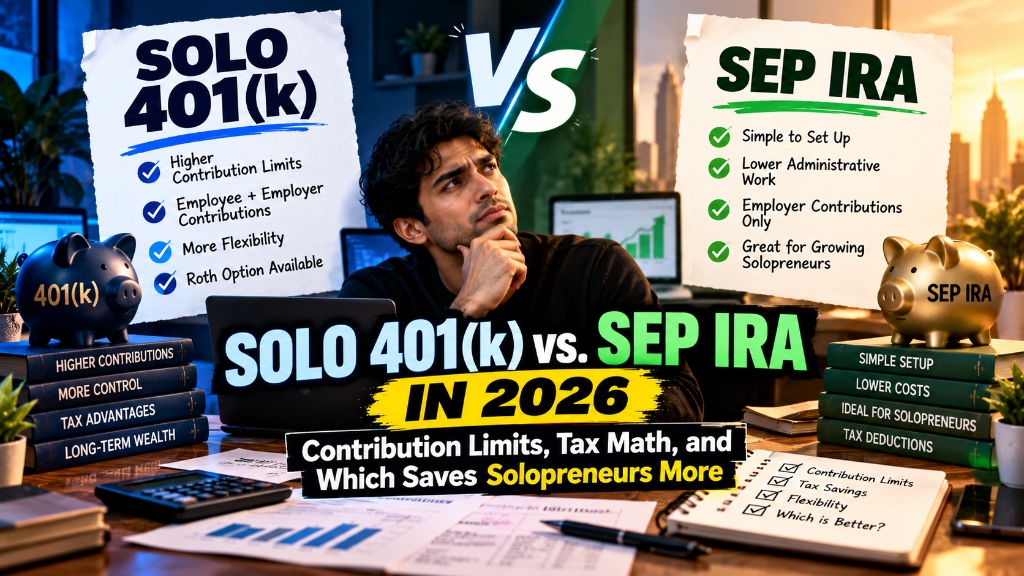
Solo 401(k) vs. SEP IRA in 2026: Contribution Limits and Tax Math
Compare Solo 401(k) vs SEP IRA in 2026. Calculate exact contribution limits, tax deductions, and Roth options across $80k, $150k, and $250k profit tiers.
Educational Resource: This guide does not constitute financial or legal counsel.
The Solo 401(k) beats the SEP IRA for the vast majority of solopreneurs in 2026 because it allows two distinct contribution buckets: employee elective deferrals plus employer profit sharing. This dual structure enables business owners to shelter significantly more taxable income at moderate earnings levels while providing access to Roth contributions, loan features, and clean backdoor Roth IRA execution.
High-earning solopreneurs, independent contractors, and single-member LLC owners share a common financial objective: reducing current tax bills while aggressively compounding wealth for retirement.
Standard individual retirement accounts (traditional and Roth IRAs) carry strict annual contribution limits (capped under $10,000 per individual), which barely scratch the surface of a six-figure business profit. When self-employment income scales, choosing the right tax-advantaged account becomes your single most powerful financial lever.
The two primary vehicles for self-employed individuals without full-time W-2 employees are the Solo 401(k) (also known as an Individual 401k) and the Simplified Employee Pension (SEP IRA).
While both accounts allow substantial tax deductions, their internal mathematical mechanics, administrative rules, and flexibility differ drastically. Here is the side-by-side financial breakdown for 2026, featuring real tax modeling across $80,000, $150,000, and $250,000 profit tiers.
Structural Showdown: How Contributions Are Calculated in Both Plans
The core difference between a Solo 401(k) and a SEP IRA lies in how many distinct contribution roles you can claim as a business owner.
In a SEP IRA, all contributions are classified strictly as employer profit-sharing contributions. You act solely as the employer. Under IRS regulations, you can contribute up to 25% of your W-2 wages if your business is taxed as an S-Corporation, or approximately 20% of net adjusted self-employment earnings if you operate as a Sole Proprietorship or single-member LLC.
In a Solo 401(k), you wear two separate hats: you are both the employee and the employer. This structural duality unlocks two separate contribution buckets:
| Solo 401(k) Bucket | 2026 Contribution Limit | Tax Classification Options |
|---|---|---|
| Bucket 1: Employee Elective Deferral | Up to $23,500 ($31,000 if age 50+) | Traditional Pre-Tax or Designated Roth |
| Bucket 2: Employer Profit Sharing | Up to 25% of W-2 (or ~20% of net SE profit) | Traditional Pre-Tax Business Deduction |
| Total Combined Statutory Limit | Up to $70,000 ($77,500+ with catch-up) | High-volume sheltered wealth acceleration |
Because the Solo 401(k) allows you to contribute your initial employee dollars off the top before calculating your 20% to 25% employer profit share, it permits substantially larger total contributions at lower and middle profit levels.
Contribution Caps & Rules for the 2026 Tax Year
For the 2026 tax year, the Internal Revenue Service establishes maximum annual addition limits under Section 415(c).
| Metric / Rule | Solo 401(k) (2026 Limits) | SEP IRA (2026 Limits) | Advantage |
|---|---|---|---|
| Employee Elective Deferral Cap | Up to $23,500 | Not permitted ($0) | Solo 401(k) |
| Employer Profit Sharing Cap | 25% of W-2 (or ~20% of net SE) | 25% of W-2 (or ~20% of net SE) | Tie |
| Combined Maximum Total Cap | $70,000 (pre-catch-up) | $70,000 (pre-catch-up) | Tie |
| Catch-Up Contribution (Age 50+) | Additional $7,500 to $11,250 (SECURE 2.0) | None allowed | Solo 401(k) |
| Roth Contribution Option | Available for employee deferrals | Available (SECURE 2.0, but rare at brokers) | Solo 401(k) |
| Participant Loan Feature | Borrow up to $50,000 or 50% of balance | Strictly prohibited by IRS | Solo 401(k) |
| Annual IRS Filing Requirement | Form 5500-EZ once assets exceed $250k | None (No annual reporting) | SEP IRA |
Under SECURE Act 2.0 provisions active in 2026, participants aged 60 through 63 receive an enhanced catch-up contribution limit of up to $11,250 in their Solo 401(k), making it an extraordinary catch-up vehicle for seasoned entrepreneurs.
Side-by-Side Math: Scenarios at $80,000, $150,000, and $250,000 Net Profit
To understand why the Solo 401(k) dominates at most income levels, look at the concrete mathematical contribution capacity for a sole proprietor or single-member LLC across three common income tiers.
(Calculations assume a sole proprietor filing single, accounting for the deduction of half of self-employment tax before determining the net business profit base).
| Plan Type | Employee Deferral | Employer Profit Share | Total Tax Shelter | Extra Sheltered by Solo 401(k) |
|---|---|---|---|---|
| SEP IRA | $0 (Not allowed) | $14,870 | $14,870 | Baseline |
| Solo 401(k) | $23,500 | $14,870 | $38,370 | +$23,500 (+158%) |
(Scenario 1: $80,000 Net Business Profit. At $80k net, a Solo 401(k) user shelters over 47% of net profit from taxes).
At $80,000 in net earnings, a solopreneur using a Solo 401(k) can shelter over 47% of their total gross profit from federal income taxes, whereas a SEP IRA user is capped at less than $15,000.
| Plan Type | Employee Deferral | Employer Profit Share | Total Tax Shelter | Extra Sheltered by Solo 401(k) |
|---|---|---|---|---|
| SEP IRA | $0 (Not allowed) | $27,880 | $27,880 | Baseline |
| Solo 401(k) | $23,500 | $27,880 | $51,380 | +$23,500 (+84%) |
(Scenario 2: $150,000 Net Business Profit).
At $150,000 in business earnings, the Solo 401(k) allows an investor to surpass the $50,000 investment milestone in a single calendar year, generating roughly $7,500 to $9,000 in direct tax savings depending on their state tax bracket.
| Plan Type | Employee Deferral | Employer Profit Share | Total Tax Shelter | Extra Sheltered by Solo 401(k) |
|---|---|---|---|---|
| SEP IRA | $0 (Not allowed) | $46,500 | $46,500 | Baseline |
| Solo 401(k) | $23,500 | $46,500 | $70,000 (Max Limit) | +$23,500 (+50%) |
(Scenario 3: $250,000 Net Business Profit).
[!IMPORTANT] In order to max out a SEP IRA at the $70,000 limit, a sole proprietor must earn approximately $350,000 in net profit. With a Solo 401(k), you achieve the maximum $70,000 contribution at roughly $235,000 in net income.
The Deciding Factors: Catch-Up Limits, Roth Options, and Loan Provisions
Beyond raw tax mathematics, three major structural features separate these accounts:
1. Roth Flexibility and the Backdoor Roth IRA Trap
One of the most dangerous hidden traps of a SEP IRA is the Pro-Rata Rule (IRS Form 8606). If you hold pre-tax balances in a SEP IRA, you cannot perform a clean backdoor Roth IRA conversion for your personal accounts without triggering taxable distributions.
By contrast, assets inside a Solo 401(k) are completely shielded from the pro-rata rule, leaving your backdoor Roth pathway clear. Furthermore, modern Solo 401(k) plan documents allow designated Roth 401(k) employee deferrals and after-tax mega backdoor Roth conversions.
2. Participant Loan Capability
Life and business happen unpredictably. A Solo 401(k) plan allows you to borrow up to 50% of your vested account balance (up to a maximum of $50,000) with zero tax penalties. You repay the loan principal and interest back to yourself over five years at the prime rate.
Borrowing from a SEP IRA is classified by the IRS as an illegal prohibited transaction, triggering immediate disqualification, full taxes, and a 10% early withdrawal penalty.
3. Catch-Up Contributions for Older Savers
Entrepreneurs aged 50 and older can contribute an additional $7,500 into their Solo 401(k), pushing total contributions up to $77,500. Under SECURE 2.0, savers aged 60 to 63 can contribute up to $11,250 in catch-ups. SEP IRAs offer zero catch-up provisions under any circumstances.
[!TIP] If you are mapping out long-term retirement compounding trajectories across various asset allocations, model your expected post-retirement portfolio using our Eternity Empire Compound Interest Calculator.
Administrative Responsibilities: Form 5500-EZ Filings and Deadlines
While the Solo 401(k) offers superior mathematical and structural power, it carries one specific administrative compliance task that the SEP IRA avoids.
When the total combined assets in your Solo 401(k) plan (including all traditional, Roth, and voluntary after-tax balances across all business accounts) reach $250,000 or more at the end of the plan year, you must file IRS Form 5500-EZ annually.
- Filing Deadline: Form 5500-EZ must be submitted by the last day of the seventh month following the close of your plan year (July 31 for calendar-year plans).
- Penalties for Late Filing: The IRS penalty for late filing of Form 5500-EZ is severe: $250 per day, up to a maximum of $150,000 per plan year. Fortunately, you can file Form 5500-EZ electronically for free using the Department of Labor’s EFAST2 system, or your specialized Solo 401(k) provider will generate it automatically.
- SEP IRA Simplicity: A SEP IRA requires zero annual government filings, regardless of whether your balance is $10,000 or $5,000,000. It is established with a simple one-page IRS Form 5305-SEP kept in your business records.
Step-by-Step Decision Matrix: Which Account to Open First
Use this practical decision matrix to select the optimal retirement plan for your business profile:
- Do you employ non-spouse W-2 staff? If yes, neither plan qualifies for solo status; set up a Safe Harbor 401(k) or classic SEP.
- Is your priority zero administrative setup and you earn under $60,000? If yes, a SEP-IRA provides rapid account opening without annual Form 5500 filings.
- Do you want to maximize contributions, access Roth accounts, or preserve Backdoor Roths? If yes, the Solo 401(k) is the mathematically superior choice.
Choose the Solo 401(k) If:
- You earn between $60,000 and $250,000 and want to maximize current-year tax deductions.
- You want the option to make Roth contributions.
- You perform annual Backdoor Roth IRA conversions and must avoid the pro-rata rule.
- You want the safety net of borrowing up to $50,000 from your retirement assets.
- You are over age 50 and want catch-up contribution limits.
Choose the SEP IRA If:
- You earn over $350,000 in net profit (where both plans hit the $70,000 maximum limit anyway) and you refuse to file an annual Form 5500-EZ once assets exceed $250,000.
- You are establishing the account at the absolute last minute (SEP IRAs can be opened and funded up until your tax filing deadline, including extensions).
Frequently Asked Questions
Can I contribute to both a Solo 401(k) and a SEP IRA in the same year?
No, you cannot contribute to both a Solo 401(k) and a SEP IRA for the same business entity in the same tax year. The IRS considers them overlapping qualified retirement plans subject to the shared Section 415(c) aggregate contribution ceiling.
Does a day-job 401(k) limit my Solo 401(k) contributions?
Yes, the employee elective deferral limit ($23,500 in 2026) applies per person across all employer plans combined. If you contribute $23,500 to a corporate 9-to-5 employer 401(k), you cannot make employee deferrals into your Solo 401(k). However, you can still contribute up to 20% to 25% of your side-business net income as employer profit sharing.
Can my spouse participate in my Solo 401(k)?
Yes, if your spouse earns legitimate W-2 wages or self-employment income from your business, they can participate as a second participant in your Solo 401(k). This effectively doubles your household contribution capacity to up to $140,000 per year ($70,000 each).
What happens to my Solo 401(k) if I hire full-time employees?
If you hire a non-owner employee who works more than 1,000 hours in a calendar year (or 500 hours annually over three consecutive years under SECURE 2.0 rules), your business no longer qualifies for a Solo 401(k). You must either convert the plan into a standard corporate 401(k) or terminate the plan and roll the assets into an IRA.
Final Strategy: Take Action Before the Tax Year Closes
Selecting between a Solo 401(k) and a SEP IRA is not an academic debate; it is an immediate financial decision that determines whether thousands of dollars stay on your balance sheet or disappear into federal tax revenue.
For over 90% of solopreneurs, the Solo 401(k) is the indisputable champion. Its ability to absorb $23,500 off the top as an employee deferral, shelter you from the backdoor Roth pro-rata rule, and allow Roth contributions makes it the most flexible wealth creation vehicle in modern personal finance.
Evaluate your net business profit today, consult with your tax advisor, and establish your retirement account before year-end deadlines close.
Download: The Solo Founder's High-Margin Scaling Playbook
A battle-tested blueprint on building asymmetric leverage, packaging high-ticket B2B services, and converting labor into scalable digital products.
- Pricing power & contract negotiation scripts
- Micro-SaaS & digital product launch checklist
This article and its associated calculators are for educational and informational purposes only and do not constitute financial, investment, legal, tax, or medical advice. We may earn an affiliate commission on third-party links at zero cost to you. Always consult a licensed professional before making major financial, health, or investment decisions. Read our full Legal & Financial Disclaimer.
Vikram Nair
Verified AuthorVikram covers small business ideas, digital ventures, and practical company growth. Having worked alongside early-stage founders, he writes straightforward advice on building profitable businesses.
Was this essay valuable to you?
Help us refine our editorial focus and research priorities.
Reader Discussion (2)
Extremely well-articulated analysis on capital compounding. The breakdown on equity allocation vs active income is spot on.
The distinction between looking rich and building real moats is something more founders need to study deeply.
Explore Eternity Empire
Search empirical insights, explore our four wisdom categories, and discover curated strategic essays.
Search Insights
Recent Essays
The Backyard Cash Flow Engine: How to House Hack with an ADU in 2026
11 min read • Oct 20How to Become a Fractional COO: Landing Your First $5,000/Month Retainer Client
12 min read • Oct 20The Zero-Bounce Outbound Engine: How to Set Up Multi-Domain Cold Email with Instantly and Clay
12 min read • Oct 20Featured Guides
Further Wisdom & Insights
Explore All Articles
When to Elect S-Corp Status for Your LLC: The $80,000 Profit Rule and Reasonable Salary Math
Discover when to elect S-Corp for single member LLC status. Learn the $80,000 net profit threshold, reasonable salary rules, and Form 2553 filing deadlines.

Coast FIRE Explained: How to Frontload Retirement and Downshift Work in Your 30s
Master the Coast FIRE calculator and milestone strategy. Learn the exact math to frontload retirement savings and downshift into low-stress work in your 30s.
The HSA Shoebox Strategy: How to Turn a Health Savings Account into a Tax-Free Stealth IRA
Master the HSA shoebox strategy to turn healthcare savings into a tax-free stealth IRA. Learn delayed reimbursement rules, record-keeping, and custodian picks.