

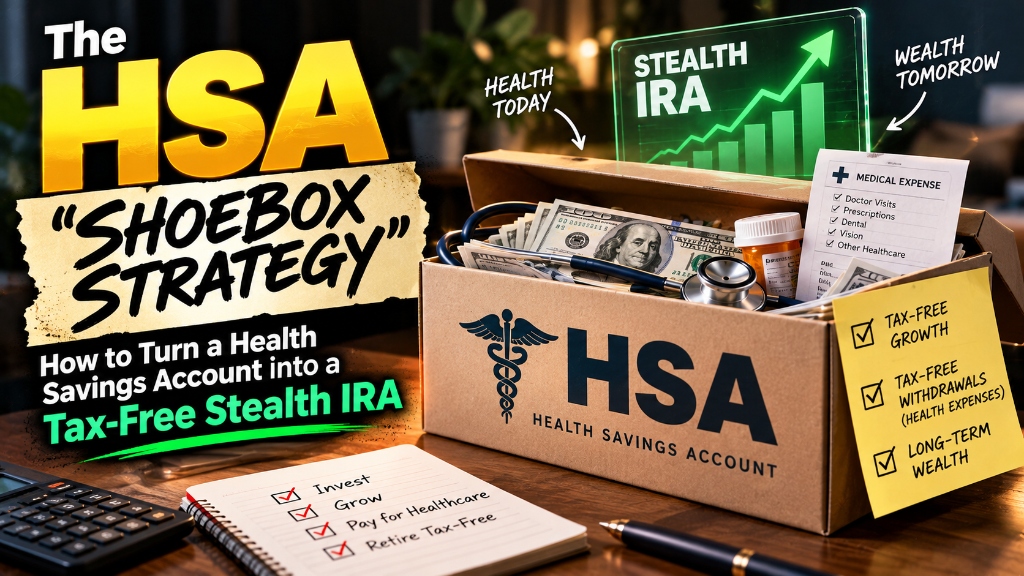
The HSA Shoebox Strategy: How to Turn a Health Savings Account into a Tax-Free Stealth IRA
Master the HSA shoebox strategy to turn healthcare savings into a tax-free stealth IRA. Learn delayed reimbursement rules, record-keeping, and custodian picks.
Educational Resource: This guide does not constitute financial or legal counsel.
Direct Answer: The HSA stealth IRA investment strategy involves paying current out-of-pocket medical expenses with regular cash flow while leaving your Health Savings Account balance invested in broad-market index funds. Because IRS Section 223 imposes no deadline on qualified medical reimbursements, you can let your investments compound tax-free for decades before reimbursing yourself tax-free in retirement.
Most working professionals treat their Health Savings Account (HSA) like a glorified medical debit card.
They contribute pre-tax dollars through payroll, incur a dental bill or prescription copay, swipe their branded plastic card, and immediately drain their balance back to zero. While this routine saves a modest slice of federal income tax on annual health visits, it sacrifices one of the most powerful wealth-compounding mechanisms written into the United States Internal Revenue Code.
When paired with a High Deductible Health Plan (HDHP), an HSA can be transformed into an aggressive, tax-shielded investment vehicle: a stealth retirement account that outperforms both the Traditional 401(k) and the Roth IRA.
The playbook for unlocking this tax shelter is known among financial planners and early retirement advocates as the “Shoebox Strategy.” Here is how the mechanics work, how to maintain strict IRS compliance across decades, and how to build a digital archiving vault for your medical expenses.
The Triple Tax Advantage: Why HSAs Beat 401(k)s and Roth IRAs
The Health Savings Account provides a rare triple tax advantage that shields contributions, investment growth, and qualified withdrawals from all federal taxation.
Traditional retirement accounts force a trade-off between upfront tax deductions and tax-free distributions down the road. A Traditional 401(k) gives you an immediate pre-tax deduction, but taxes your withdrawals as ordinary income in retirement. Conversely, a Roth IRA uses after-tax contributions to deliver tax-free withdrawals in your later years.
An HSA eliminates this trade-off by combining both benefits into a single structure:
- Pre-Tax Contributions: Money deposited via payroll deduction bypasses federal income tax, state income tax (in 48 states, excluding California and New Jersey), and standard FICA taxes (6.2% Social Security and 1.45% Medicare).
- Tax-Free Growth: Dividends, interest, and capital gains earned inside an invested HSA incur zero capital gains taxes year after year.
- Tax-Free Distributions: Withdrawals used to reimburse qualified medical expenses are permanently exempt from federal income taxes at any age.
No other investment account in the American tax system permits tax-free entry, tax-free compounding, and tax-free exit simultaneously.
The Mechanics of the “Shoebox Strategy” (Pay Cash Now, Reimburse Decades Later)
The shoebox strategy functions by paying current medical costs out of pocket today while accumulating and preserving receipts for tax-free reimbursement decades later.
Under IRS Section 223, there is no statutory deadline or expiration date governing when an account holder must claim reimbursement for a qualified medical expense. As long as the medical expense occurred after the date your HSA was legally established, you are permitted to reimburse yourself ten, twenty, or thirty years into the future.
The operational workflow follows three straightforward steps:
- Step 1: Incur and Pay Out of Pocket: When you visit an optometrist, pay a surgical deductible, or purchase eligible medical supplies, pay the invoice using your regular rewards credit card or checking account. Do not touch your HSA cash.
- Step 2: Invest 100% of Your HSA Balance: Allocate your deposited HSA funds into low-cost, broad-market index funds (such as an S&P 500 or total world stock market fund) to capture maximum compound returns over a multi-decade horizon.
- Step 3: Archive Proof of Payment: Store an itemized digital receipt and proof of out-of-pocket payment in a secure cloud folder. When you reach retirement, you can withdraw thousands in accumulated receipts tax-free for travel, living expenses, or mortgage payments.
Consider the compounding math: paying a $2,000 dental surgery bill out of your checking account allows $2,000 inside your HSA to grow at an annualized 8% return. Over 25 years, that single $2,000 balance compounds into roughly $13,697. You can then withdraw your original $2,000 tax-free against the archived receipt, leaving $11,697 in pure, tax-sheltered wealth behind to continue growing.
IRS Compliance: Exact Documentation Needed for Audits 20 Years From Now
IRS compliance for delayed HSA reimbursements requires proving the date the HSA was established, verifying the expense was medically qualified, and documenting that the expense was never deducted on another tax return.
If the IRS audits your tax return decades from now when you withdraw $40,000 of accumulated medical expenses, you must produce clear contemporaneous documentation. Relying on paper thermal receipts stored in an actual cardboard shoebox is dangerous because thermal ink fades into illegible blank paper within five to seven years.
To satisfy the substantiation requirements of IRS Publication 969, your digital records must capture four distinct data points:
- HSA Establishment Date Proof: A copy of your very first HSA account statement or formal welcome letter demonstrating that the account was officially active before the medical expenses were incurred.
- Itemized Explanation of Benefits (EOB) or Provider Invoice: The document must explicitly state the patient name, date of service, description of medical care, and net amount owed after insurance adjustments.
- Proof of Out-of-Pocket Payment: A matching credit card statement line, cancelled check copy, or bank debit record proving that you paid the bill personally rather than having it paid by insurance or a flexible spending account (FSA).
- Statement of Non-Itemization: Written confirmation that you did not claim these same expenses as itemized deductions on Schedule A of IRS Form 1040 in the year they occurred.
Building a Frictionless Digital Receipt Storage System (Google Drive + Sheets Vault)
A frictionless digital receipt storage system pairs a dedicated cloud folder structure with an indexed Google Sheet to ensure rapid receipt retrieval during tax season.
Setting up this tracking vault takes less than fifteen minutes:
1. Configure the Cloud Storage Hierarchy
Create a top-level folder in Google Drive, Dropbox, or OneDrive labeled HSA_Receipt_Vault_Confidential. Inside, create subfolders organized by tax year (2026_Medical_Receipts, 2027_Medical_Receipts).
2. Standardize Your File Naming Protocol
Never upload generic phone photo names like IMG_4021.jpg. Standardize every scanned PDF or image using this strict schema:
YYYY-MM-DD_ProviderName_ServiceDescription_Amount.pdf
For example: 2026-04-12_LabCorp_BloodPanel_$184.50.pdf
3. Maintain the Master Reimbursement Ledger
Create a Google Sheet with the following data columns to track your lifetime claimable balance:
| Service Date | Patient | Healthcare Provider | Service Description | Out-of-Pocket Cost | Receipt PDF Link | Reimbursement Status |
|---|---|---|---|---|---|---|
| 2026-02-14 | Jane Doe | Apex Dental Care | Annual Cleaning & X-Rays | $245.00 | [Drive Link] | Unclaimed |
| 2026-05-19 | John Doe | Valley Vision Center | Prescription Lenses | $380.00 | [Drive Link] | Unclaimed |
| 2026-08-01 | Jane Doe | CVS Pharmacy | Prescribed Allergy Therapy | $65.20 | [Drive Link] | Unclaimed |
This indexed ledger acts as your running account balance of accumulated, tax-free cash reserves available on demand whenever emergency liquidity is required.
Best HSA Custodians for Low-Cost Index Fund Investing (Fidelity vs. Lively vs. HealthEquity)
Selecting the right HSA custodian ensures your contributions compound without predatory administrative fees or mandatory cash balance holding minimums.
Many employer-sponsored HSA administrators impose high monthly maintenance fees or force participants to keep $1,000 to $2,000 in uninvested cash earning near-zero interest. If your employer uses a suboptimal provider, you have the legal right under IRS rules to perform periodic trustee-to-trustee rollovers into a self-directed personal HSA custodian.
Fidelity Investments (The Industry Benchmark)
Fidelity is the gold standard for independent HSA investors. It charges zero monthly maintenance fees, zero investment trading commissions, and enforces no minimum cash balance requirements. You can invest every single dollar from day one into zero-expense-ratio index funds (like FZROX or FNILX) or fractional shares of total stock market ETFs.
Lively HSA
Lively provides an intuitive, user-friendly digital interface designed specifically for modern consumers. Investment capabilities are powered through an integrated Schwab brokerage connection. While Lively previously charged an annual fee for investment access, its individual accounts now offer low-friction investing suitable for automated regular deposits.
HealthEquity
HealthEquity is one of the largest corporate providers chosen by employer benefits teams. However, for self-directed investors, it often requires maintaining a minimum cash threshold (frequently $500 to $1,000) before allowing investment transfers, and it imposes subtle investment administrative fees on Vanguard fund balances. If your employer deposits company matching funds into HealthEquity, consider keeping the account open for payroll matches while transferring surplus balances to Fidelity annually.
Comparison Table: Traditional Retirement Vehicles vs. The Invested HSA
| Investment Account Feature | Traditional 401(k) | Roth IRA | Taxable Brokerage | Invested HSA (Shoebox Method) |
|---|---|---|---|---|
| Upfront Tax Deduction | Yes (Reduces taxable income) | No (Funded with post-tax cash) | No | Yes (Includes FICA exemption) |
| Annual Contribution Limit (2026) | $23,500 ($31,000 if 50+) | $7,000 ($8,000 if 50+) | Unlimited | $4,300 Individual / $8,550 Family |
| Tax-Free Growth & Dividends | Tax-deferred until payout | Yes (Zero capital gains tax) | No (Annual drag on dividends) | Yes (Completely tax-free) |
| Tax-Free Withdrawals | No (Taxed as ordinary income) | Yes (Qualified distributions) | No (Capital gains tax owed) | Yes (For all medical receipts) |
| Early Withdrawal Penalty | 10% penalty before 59.5 | 10% on earnings before 59.5 | None | None (Against saved receipts) |
| Required Minimum Distributions | Yes (Begins at age 73/75) | None during owner lifetime | None | None (No RMDs ever required) |
What Happens to Your HSA at Age 65: Medicare and Non-Medical Withdrawals
At age 65, your HSA rules automatically broaden, transforming the account into an equivalent Traditional IRA for non-medical expenses while maintaining tax-free withdrawals for healthcare.
Once you reach age 65, the restrictive 20% early withdrawal penalty for non-qualified expenses permanently disappears:
- Non-Medical Expenses: You can withdraw funds for any purchase (groceries, new vehicles, vacations). You simply pay ordinary state and federal income taxes on the distribution, identical to withdrawals from a Traditional 401(k) or Traditional IRA.
- Qualified Medical Expenses: Withdrawals for qualified medical expenses remain 100% tax-free. At this stage of life, your accumulated HSA balance can cover Medicare Part B and Part D premiums, long-term care insurance premiums (up to IRS age limits), and out-of-pocket dental or hearing care that traditional Medicare excludes.
If you maintain your digital shoebox properly, you will rarely need to take taxable distributions at 65. You can simply tap your backlog of 20 to 30 years of archived receipts to extract tens of thousands in tax-free distributions whenever needed.
Frequently Asked Questions
Can you reimburse HSA expenses decades later under IRS rules?
Yes, under IRS rules you can reimburse qualified medical expenses decades after they occurred, provided your HSA was officially established before the expense date and you kept verifiable, itemized receipts proving the cost was never claimed elsewhere.
Can you buy index funds inside an HSA?
Yes, modern HSA custodians like Fidelity and Charles Schwab permit account holders to invest contributions in broad-market index funds, exchange-traded funds (ETFs), and individual stocks without restriction or penalty.
What happens if the company that held my old receipts goes out of business?
If a medical provider goes out of business, your archived Explanation of Benefits (EOB) from your health insurer alongside your personal credit card or bank payment statement serves as legally valid proof for IRS substantiation.
Does the HSA shoebox strategy work if I switch back to a low-deductible healthcare plan?
Yes, while you can only contribute new funds to an HSA while enrolled in an eligible High Deductible Health Plan (HDHP), your existing HSA balance remains invested and accessible for tax-free reimbursements for life regardless of your future health plan tier.
What happens to an invested HSA when you pass away?
If your designated beneficiary is your surviving spouse, the HSA transfers into their name and retains its complete tax-free status. If the beneficiary is a non-spouse child or heir, the account ceases to be an HSA and its fair market value becomes taxable income to the beneficiary in the year of death.
Final Thoughts: Building Your Personal Health Endowment
The healthcare system presents one of the largest financial uncertainties facing retirees.
Treating your HSA as an immediate spending account trades away exponential compound growth for minor short-term convenience. By paying routine medical bills out of current income, digitizing your receipts into an organized cloud vault, and letting low-cost index funds work uninterrupted, you construct a dedicated health endowment that shields your wealth from taxes both now and throughout retirement.
Set up your digital receipt folder today, verify your HSA investment asset allocation, and turn every routine doctor appointment into a vehicle for long-term financial independence.
Download: The 2026 Wealth Compounding & FIRE Planning Toolkit
Our complete spreadsheet model and 28-page strategic handbook covering asset allocation buckets, Indian inflation adjustments, and long-term SIP compounding.
- Interactive FIRE & Net Worth Excel/Sheets model
- Asset allocation & emergency reserve matrix
This article and its associated calculators are for educational and informational purposes only and do not constitute financial, investment, legal, tax, or medical advice. We may earn an affiliate commission on third-party links at zero cost to you. Always consult a licensed professional before making major financial, health, or investment decisions. Read our full Legal & Financial Disclaimer.
Aditya Singhania
Verified AuthorAditya writes about investing, saving habits, and smart money management. With a background in financial planning, he helps readers build simple, reliable wealth habits for the long run.
Was this essay valuable to you?
Help us refine our editorial focus and research priorities.
Reader Discussion (2)
Extremely well-articulated analysis on capital compounding. The breakdown on equity allocation vs active income is spot on.
The distinction between looking rich and building real moats is something more founders need to study deeply.
Explore Eternity Empire
Search empirical insights, explore our four wisdom categories, and discover curated strategic essays.
Search Insights
Recent Essays
The Backyard Cash Flow Engine: How to House Hack with an ADU in 2026
11 min read • Oct 20How to Become a Fractional COO: Landing Your First $5,000/Month Retainer Client
12 min read • Oct 20The Zero-Bounce Outbound Engine: How to Set Up Multi-Domain Cold Email with Instantly and Clay
12 min read • Oct 20Featured Guides
Further Wisdom & Insights
Explore All Articles
Coast FIRE Explained: How to Frontload Retirement and Downshift Work in Your 30s
Master the Coast FIRE calculator and milestone strategy. Learn the exact math to frontload retirement savings and downshift into low-stress work in your 30s.

How to Reach Financial Independence in India: Calculate Your FIRE Number
Calculate your FIRE number in India for 2026. Learn safe withdrawal rates, Indian inflation reality, Lean vs Fat FIRE, and interactive portfolio modeling.

Solo 401(k) vs. SEP IRA in 2026: Contribution Limits and Tax Math
Compare Solo 401(k) vs SEP IRA in 2026. Calculate exact contribution limits, tax deductions, and Roth options across $80k, $150k, and $250k profit tiers.