

The Reverse Budgeting System for Variable Income: A Freelancer's Guide
Master reverse budgeting for variable income. Learn how freelancers turn erratic client checks into predictable bi-weekly paychecks with buffer accounts.
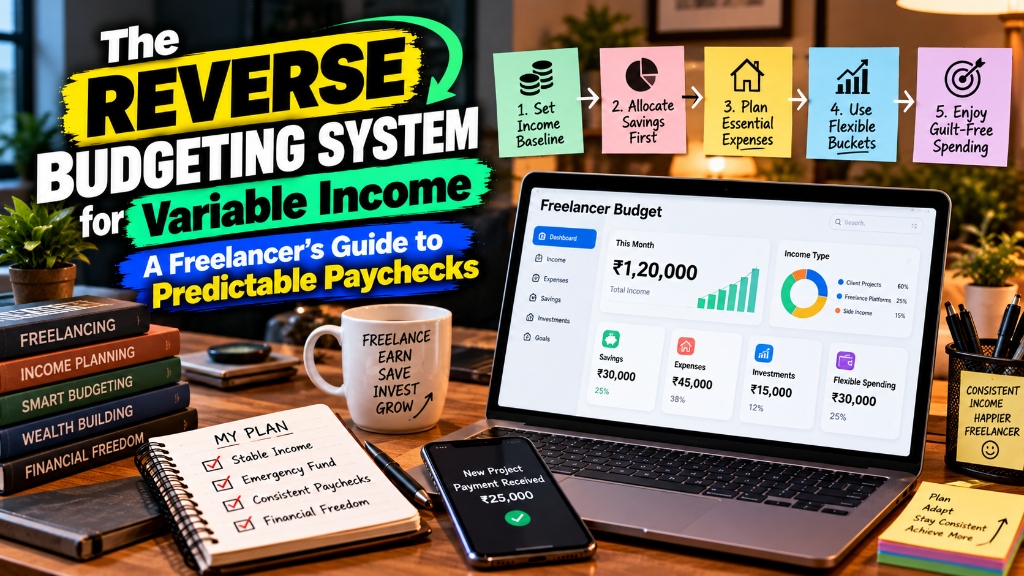
Educational Resource: This guide does not constitute financial or legal counsel.
Reverse budgeting for variable income decouples your personal lifestyle spending from fluctuating client revenue by routing all gross income through a dedicated business buffer holding account. Instead of spending directly from unpredictable invoices, you pay yourself a consistent, fixed bi-weekly salary based on your Minimum Viable Living Number while automatically reserving funds for taxes and operating expenses.
Freelancers and 1099 independent contractors face an inherent financial trap: your monthly bills arrive on rigid, fixed schedules, but your client revenue arrives in unpredictable waves.
One month you close three project retainers and collect $11,000, feeling invincible and upgrading your lifestyle. Two months later, two corporate invoices get delayed in accounts payable, leaving you with $2,400 to cover $4,500 in baseline personal commitments. This feast-or-famine whiplash creates constant financial anxiety, leading to reliance on high-interest credit cards during lean quarters.
Static budgeting rules built for salaried W-2 workers collapse under irregular cash flows. What you need is an inverted operating system: reverse budgeting for variable income.
By inserting an automated holding account between your client deposits and your personal checking account, you transform volatile freelance revenue into an artificial, guaranteed bi-weekly paycheck. Here is the exact system to build your buffer, calculate your baseline number, and manage windfall months without lifestyle inflation.
Why Traditional 50/30/20 Budgets Break on Fluctuating Income
Traditional budgeting frameworks fail variable earners because they assume a steady, predictable monthly income denominator.
The popular 50/30/20 guideline tells you to spend 50% of your take-home pay on needs, 30% on wants, and 20% on debt reduction or savings. But when your net revenue fluctuates between $3,000 and $12,000 per month, these static percentages create catastrophic distortions:
- In a $3,000 month: Your essential housing, insurance, and food bills alone might cost $3,800. Allocating 50% ($1,500) to needs is physically impossible, making you feel like a failure before the month begins.
- In a $12,000 month: Allocating 30% ($3,600) to discretionary “wants” triggers rapid lifestyle creep, encouraging luxury spending on dining and gadgets that you cannot maintain when revenue returns to normal.
| Cash Flow Model | Operating Structure | Month-to-Month Impact |
|---|---|---|
| Salaried W-2 Flow | Employer $\rightarrow$ Fixed Net Paycheck $\rightarrow$ Category Split | Predictable, static budgeting with zero income surprises |
| Unbuffered Freelance Flow | Volatile Invoices $\rightarrow$ Direct Checking $\rightarrow$ Reactive Spending | Feast-or-famine stress, high tax risk, and lifestyle creep |
Variable income requires decoupling revenue collection from personal spending. You must never spend directly out of current-month earnings. Instead, this month’s invoices must fund next month’s (or next quarter’s) living expenses.
The Holding Account Mechanism: Establishing Your Buffer Reserve
The foundation of reverse budgeting is a business holding buffer account that absorbs revenue volatility before money touches your personal wallet.
A cash flow buffer account acts as a financial shock absorber. Every incoming client payment (whether a $500 milestone or an $8,000 upfront project retainer) lands in a designated primary business holding account. You never transfer money directly from this holding account into your personal checking account to cover groceries or dinner.
Instead, the holding account acts as a dam behind a reservoir. Water flows into the reservoir unevenly, but the dam releases a steady, measured stream through the turbine.
| Architecture Component | Target Balance | Operational Function |
|---|---|---|
| Business Buffer (Holding Dam) | 2 to 3 months baseline overhead | Collects all client payments and releases predictable payouts |
| Tax Reserve Sub-Account | 25% to 30% of gross receipts | Dedicated reserve for quarterly estimated income taxes |
| Business Operating Account | 10% to 15% of monthly revenue | Covers SaaS subscriptions, tools, and contractor costs |
| Personal Salary Draw | Fixed dollar sum bi-weekly | Transferred to personal checking to simulate a steady paycheck |
The Buffer Sizing Formula
How much cash should sit in your buffer account? For most single-operator businesses and contractors, the ideal buffer reserve follows this formula:
Ideal Buffer Reserve = (Monthly Business OpEx + Personal Base Salary) × 2.5
For example, if your essential business operating expenses are $600 per month and your target personal owner salary is $4,500 per month, your combined baseline commitment is $5,100. Multiplying this by 2.5 gives an ideal holding reserve of $12,750.
Once this threshold is funded, revenue dips no longer cause panic. You continue transferring yourself your standard $2,250 every two weeks even if zero client invoices clear during that 14-day window.
The 4-Tier Split: Taxes, Business Overhead, Owner Pay, Profit
Every dollar that clears your client invoice queue must be systematically partitioned into four distinct sub-accounts before you take your salary.
Inspired by the core principles of cash flow allocation, this four-tier distribution ensures you never face a surprise five-figure tax liability or run out of money for essential software tools.
1. Tax Reserve Sub-Account (25% to 30%)
Self-employed contractors must pay self-employment tax (15.3% in the US for Social Security and Medicare) plus federal and state income taxes. Skimming 25% to 30% of every gross invoice immediately into a dedicated tax savings account guarantees quarterly estimated tax payments are painless.
2. Business Operating Expenses (OpEx) (10% to 15%)
Your business needs fuel to run: web hosting, domain renewals, Adobe Creative Cloud, accounting software, legal registrations, and client communications. Reserving 10% to 15% ensures overhead expenses are always paid from business funds rather than personal credit cards.
3. Owner’s Compensation / Salary (50% to 55%)
This is the fixed paycheck transferred to your personal household checking account on scheduled dates (for example, the 1st and 15th of every month).
4. Profit and Growth Reserve (5% to 10%)
The remaining margin accumulates as true retained earnings. This capital funds professional development, future equipment upgrades, or an end-of-year owner bonus during bumper seasons.
Calculating Your Minimum Viable Living Number (MVLN)
To set a stable personal salary, you must determine the absolute minimum monthly cash required to keep your household running.
Your Minimum Viable Living Number (MVLN) is not your dream budget; it is your non-negotiable personal survival baseline. Knowing this number gives you confidence because it tells you exactly how small a client pipeline can shrink before your core lifestyle is threatened.
| Expense Category | What Is Included | Example Monthly Cost ($) |
|---|---|---|
| Housing & Shelter | Mortgage/Rent, property tax, renters insurance | $1,800 |
| Basic Utilities | Electricity, water, natural gas, trash, home internet | $320 |
| Core Nutrition | Home-cooked groceries and essential household goods | $550 |
| Healthcare & Insurance | Health insurance premium, dental, copays, life insurance | $480 |
| Transportation | Auto loan, gas, transit pass, car insurance | $380 |
| Minimum Debt Service | Minimum obligations on student loans or credit lines | $250 |
| Digital Phone Service | Mobile phone connection | $70 |
| Total MVLN Baseline | Non-negotiable monthly survival floor | $3,850 |
If your MVLN is $3,850, your minimum target paycheck is $1,925 deposited on the 1st and 15th. In your holding account, you know you must clear at least $3,850 after taxes and operating expenses each month to remain solvent.
Once your cash flow stabilizes and your buffer account hits its 2.5-month target, you can elevate your base salary from your survival MVLN to a comfortable “Thriving Paycheck” that includes lifestyle dining, entertainment, and personal retirement investing.
[!TIP] If you are setting up long-term savings goals or planning your path to financial freedom as an independent contractor, use our Eternity Empire FIRE Calculator to determine how much portfolio capital you need to sustain your target lifestyle permanently.
Managing Windfall Months Without Lifestyle Creep
The greatest hazard for variable earners is treating an exceptional income month as the new normal baseline.
When a freelancer closes an unexpected $15,000 corporate sprint after averaging $5,000 for three months, the instinct is to immediately upgrade their vehicle, buy luxury electronics, or commit to a more expensive apartment lease. Six months later, when revenue returns to the $5,000 baseline, those new recurring expenses turn into active financial drains.
To capture windfalls without succumbing to lifestyle creep, adopt the One-Third Windfall Protocol:
-
33.3% to Debt Acceleration or Liquid Reserves: Funneled directly toward high-interest debt payoff or building an emergency cushion.
-
33.3% to Long-Term Wealth Accumulation: Invested into broad-market index funds via Solo 401(k) or SEP-IRA.
-
33.3% to Guilt-Free Lifestyle Celebration: Allocated to a one-time reward or personal experience without creating recurring expenses.
-
One-Third to Debt Elimination or Security: Channel one-third of the post-tax surplus toward paying off existing loans or padding your personal emergency fund.
-
One-Third to Future Capital Growth: Deposit one-third into broad-market index funds, a Roth IRA, or a Solo 401(k).
-
One-Third to Guilt-Free Consumption: Spend the remaining third on a memorable travel experience, high-quality gear, or a special celebration.
Because this celebration is funded with lump-sum cash rather than recurring monthly commitments, it provides immediate emotional reward without bloating your permanent monthly overhead.
Top Digital Business Checking Accounts with Native Sub-Accounts
Executing reverse budgeting requires a digital banking platform that supports multiple sub-accounts without predatory maintenance fees.
Legacy brick-and-mortar commercial banks often charge $15 to $30 monthly account fees unless you maintain large minimum balances in each separate account. Fortunately, modern business fintech platforms allow you to create multiple virtual checking accounts and automated transfer rules in a few clicks.
| Platform | Sub-Account Capability | Automated Transfer Rules | APY Interest on Reserves | Best For |
|---|---|---|---|---|
| Relay Financial | Up to 20 individual checking accounts | Advanced percentage-based auto-splits | Up to 3.0% on savings tiers | Perfect for full Profit-First and reverse budgeting splits |
| Mercury Bank | Multiple accounts and custom debit cards | Programmatic rule triggers and API integrations | Treasury yield options for balances over $250k | Tech solopreneurs, digital agencies, funded freelancers |
| Found | Built-in tax sub-accounts and invoicing | Automatic tax withholding calculation | Standard interest on core savings | Solo contractors wanting integrated bookkeeping and taxes |
| Novo | “Novo Reserves” for budget partitioning | Percentage rules for incoming invoice deposits | Partner yield integrations | Freelancers wanting simple, visual expense bucketing |
Relay and Mercury lead the space for contractors adopting reverse budgeting. Relay in particular allows you to set up automatic percentage-based allocation rules: whenever a client wire or stripe payment arrives in Account #1 (Income Holding), the system automatically routes 30% to Taxes, 15% to OpEx, and leaves the balance ready for salary disbursements.
Step-by-Step Implementation: From Volatile Invoices to Your First Steady Paycheck
Transitioning from chaotic cash flow to automated reverse budgeting requires a four-week transition process.
- Week 1: Audit & Baseline: Calculate your exact Minimum Viable Living Number (MVLN) and average monthly business expenses over the past six months.
- Week 2: Bank Architecture: Set up a business bank account with dedicated sub-accounts for income, taxes, operating expenses, and salary.
- Week 3: Reroute Incoming Cash: Update payment details across all clients, invoicing tools, Stripe, and PayPal to route directly to the buffer.
- Week 4: Issue Your First Paycheck: Schedule your first automated, fixed bi-weekly salary transfer from the buffer to personal checking.
Step 1: Total Your Rolling Six-Month Outflow
Pull bank statements from the previous six months. Separate business operating costs from personal spending. Calculate your average monthly personal burn and your exact survival MVLN.
Step 2: Establish the Four Sub-Accounts
Open accounts with a modern digital provider like Relay or Mercury. Name the accounts clearly:
01 - Client Income Holding02 - Tax Reserve (Do Not Touch)03 - Business Operating Overhead04 - Owner Salary Staging
Step 3: Direct All Billing Rails to the Holding Account
Change the deposit settings on your merchant processors (Stripe, Square, PayPal) and update your invoice remittance instructions so that every client transfer lands exclusively in Account 01 - Client Income Holding.
Step 4: Schedule Automated Payday Transfers
Set up a recurring automated transfer from your business checking account to your personal household checking account for your target salary amount on the 1st and 15th of each month.
Treat this paycheck as sacred. If you feel like spending more on personal luxuries during high-revenue months, let that surplus build your buffer until your quarterly profit distribution arrives.
Frequently Asked Questions
What should I do if my buffer account empties during a dry spell?
If an extended market downturn drains your buffer reserve, immediately trigger your MVLN survival mode by pausing all non-essential personal subscriptions and business software. Supplement shortfalls by offering targeted flash discount audit sessions to past clients or taking short-term contract work before tapping emergency credit lines.
How is reverse budgeting different from the Profit First methodology?
Reverse budgeting focuses primarily on smoothing unpredictable personal compensation for variable earners, whereas Profit First is an overall business cash management philosophy. Both systems share the core architecture of multi-account percentage splits, but reverse budgeting prioritizes the holding buffer to guarantee predictable household paychecks.
Should my buffer account sit in checking or a high-yield savings account?
Keep one month of baseline operating expenses and salary in liquid checking to handle upcoming auto-pay obligations, and place the remaining 1.5 to 2 months of buffer reserves in a business high-yield savings account or short-term treasury fund to earn risk-free yield on idle capital.
How often should I increase my base personal salary?
Review your personal salary bi-annually. Only increase your base bi-weekly salary if your rolling 12-month average client collections have risen sustainably and your holding account comfortably maintains at least 2.5 months of higher overhead reserves.
Take Control of Your Freelance Cash Flow
Operating as an independent contractor or freelancer should give you autonomy and creative freedom, not chronic financial dread.
The feast-or-famine cycle is not an inevitable tax on self-employment; it is simply the byproduct of using an outdated budgeting system designed for corporate salary workers. By deploying reverse budgeting for variable income, creating a dedicated holding buffer, and paying yourself on a fixed bi-weekly schedule, you bring corporate-level stability to your solo enterprise.
Open your sub-accounts this week, calculate your Minimum Viable Living Number, and give yourself the predictable paycheck you deserve.
Download: The 2026 Wealth Compounding & FIRE Planning Toolkit
Our complete spreadsheet model and 28-page strategic handbook covering asset allocation buckets, Indian inflation adjustments, and long-term SIP compounding.
- Interactive FIRE & Net Worth Excel/Sheets model
- Asset allocation & emergency reserve matrix
This article and its associated calculators are for educational and informational purposes only and do not constitute financial, investment, legal, tax, or medical advice. We may earn an affiliate commission on third-party links at zero cost to you. Always consult a licensed professional before making major financial, health, or investment decisions. Read our full Legal & Financial Disclaimer.
Aditya Singhania
Verified AuthorAditya writes about investing, saving habits, and smart money management. With a background in financial planning, he helps readers build simple, reliable wealth habits for the long run.
Was this essay valuable to you?
Help us refine our editorial focus and research priorities.
Reader Discussion (2)
Extremely well-articulated analysis on capital compounding. The breakdown on equity allocation vs active income is spot on.
The distinction between looking rich and building real moats is something more founders need to study deeply.
Explore Eternity Empire
Search empirical insights, explore our four wisdom categories, and discover curated strategic essays.
Search Insights
Recent Essays
The Backyard Cash Flow Engine: How to House Hack with an ADU in 2026
11 min read • Oct 20How to Become a Fractional COO: Landing Your First $5,000/Month Retainer Client
12 min read • Oct 20The Zero-Bounce Outbound Engine: How to Set Up Multi-Domain Cold Email with Instantly and Clay
12 min read • Oct 20Featured Guides
Further Wisdom & Insights
Explore All Articles
How to Use ChatGPT & Claude for Personal Finance: 15 Copy-Paste Prompts
Master personal finance using ChatGPT and Claude. Discover 15 ready-to-run prompts for expense audits, zero-based budgeting, and net worth forecasting.

Debt Snowball vs. Avalanche in a High-Interest Era: The Hybrid Method
Compare debt snowball vs avalanche in high-interest rate environments. Discover the hybrid Cash-Flow Firefighter method to eliminate 25%+ APR card debt fast.

How to Save Money on a Low Salary: A Practical Monthly Budget Plan
Learn how to save money on a low salary with a realistic monthly budget plan. Includes sample budget templates, expense reduction tactics, and savings automation.