

How to Save Money on a Low Salary: A Practical Monthly Budget Plan
Learn how to save money on a low salary with a realistic monthly budget plan. Includes sample budget templates, expense reduction tactics, and savings automation.
Educational Resource: This guide does not constitute financial or legal counsel.
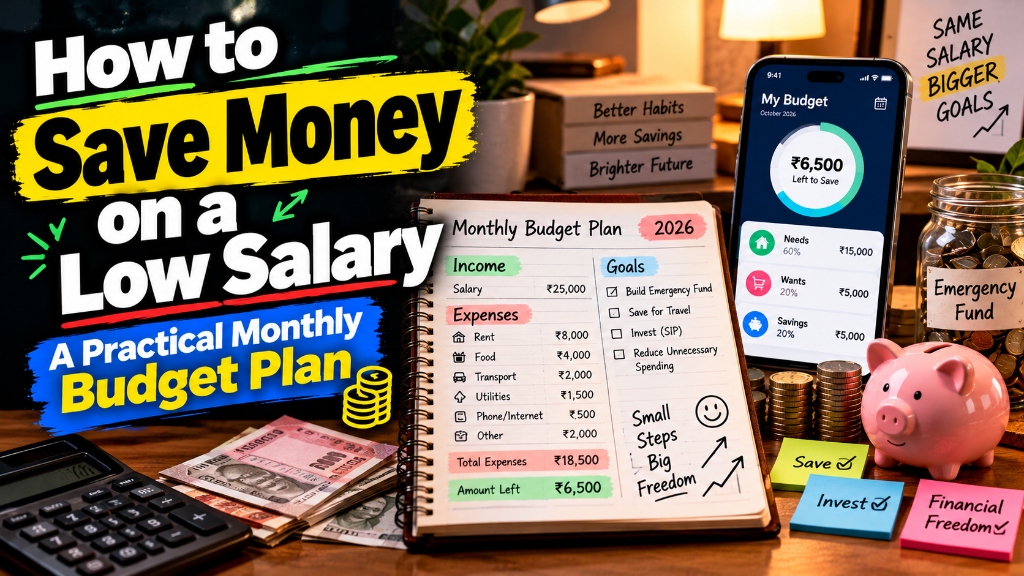
Saving money on a low salary requires flipping traditional accounting on its head: pay yourself first on payday, eliminate the big three fixed costs (housing, transport, grocery waste), and automate small, non-negotiable weekly transfers. Even setting aside 10% to 15% builds a vital emergency fund that keeps you out of high-interest debt traps.
Telling someone to “just stop buying takeout coffee” when their paycheck barely covers rent, groceries, and basic utilities is condescending financial advice.
When you earn a modest income, your challenge is not reckless luxury spending. The real friction point is structural: fixed survival expenses consume 80% to 90% of your take-home pay, leaving virtually zero margin for error. A single unexpected vehicle repair, dental procedure, or sudden rent increase can push you directly into high-interest credit card debt or personal loans that take years to dismantle.
Building financial breathing room on a low salary is entirely possible, but it requires a realistic monthly framework rather than theoretical math. This guide provides concrete, field-tested budgeting plans, sample income breakdowns, and practical expense reduction tactics designed for real life in 2026.
Can You Really Save Money on a Low Salary?
Yes, you can save money on a low salary by focusing on the “pay yourself first” principle and aggressively managing your major fixed costs rather than obsessing over minor daily expenses.
The mistake most people make is waiting until the end of the month to save whatever cash happens to be leftover. Inevitably, spontaneous expenses expand to absorb every unallocated dollar or rupee.
When you flip this sequence by automatically transferring 10% of your salary into a separate savings account the exact morning your paycheck lands, your lifestyle naturally adapts to the remaining 90%. Over twelve months, those small automated deposits accumulate into a financial cushion that grants you peace of mind.
Sample Monthly Budget Plans Across 3 Real Income Levels
The table below demonstrates how to realistically allocate monthly take-home income across essentials, debt payoff, emergency savings, and discretionary breathing room for three common income brackets.
| Budget Category | Entry-Level Take-Home (₹25,000 / $1,800) | Mid-Tier Take-Home (₹40,000 / $2,800) | Stable Take-Home (₹60,000 / $4,200) | Recommended Target % |
|---|---|---|---|---|
| Rent & Housing Utilities | ₹10,000 (40%) | ₹14,000 (35%) | ₹18,000 (30%) | 30% to 40% maximum |
| Groceries, Food & Essentials | ₹6,000 (24%) | ₹8,000 (20%) | ₹10,000 (16.7%) | 15% to 25% |
| Transportation & Fuel / Transit | ₹2,500 (10%) | ₹3,500 (8.8%) | ₹5,000 (8.3%) | 8% to 10% |
| Emergency Savings Buffer | ₹2,500 (10%) | ₹4,500 (11.2%) | ₹8,000 (13.3%) | 10% to 15% |
| Wealth Compounding / Long-Term SIP | ₹1,500 (6%) | ₹4,000 (10%) | ₹10,000 (16.7%) | 5% to 20% |
| Healthcare, Insurance & Debt Buffer | ₹1,500 (6%) | ₹3,500 (8.8%) | ₹5,000 (8.3%) | 5% to 10% |
| Discretionary / Guilt-Free Spending | ₹1,000 (4%) | ₹2,500 (6.2%) | ₹4,000 (6.7%) | 5% to 10% |
| Total Monthly Allocation | ₹25,000 (100%) | ₹40,000 (100%) | ₹60,000 (100%) | 100% |
5 Practical Steps to Build a Bulletproof Budget on Low Income
Building a budget that lasts requires keeping the system lightweight enough to maintain when you are exhausted after a forty-hour workweek.
Step 1: Open a “Locked” High-Interest Emergency Account
Opening a separate savings account at an institution different from your primary checking account creates physical and psychological friction that prevents impulsive withdrawals.
If your emergency savings sit inside the exact same mobile banking app you use for daily UPI transactions or debit card purchases, you will inevitably spend that money on routine weekend expenses. Open an account with a high-interest lender (such as IDFC FIRST Bank or Equitas Small Finance Bank in India) that offers 6.5% to 7.0% interest.
Do not install the secondary banking app on your primary phone screen, and leave the physical ATM debit card inside an envelope at home. This simple barrier ensures you only touch the funds for genuine emergencies.
Step 2: Tackle the “Big Three” Fixed Living Costs
Focusing your negotiation and frugality efforts on housing, transportation, and meal planning saves hundreds of dollars every month, dwarfing the impact of coupon clipping.
- Housing: If rent consumes over 45% of your take-home pay, no amount of budgeting will save you. Consider sharing accommodation with a roommate, negotiating a lease renewal, or relocating slightly further along an efficient public transit corridor.
- Transportation: Private vehicle loans, fuel, insurance, and parking quietly bleed cash. Taking public metro transit, carpooling, or riding a two-wheeler can easily reclaim 10% of your monthly earnings.
- Meal Prep and Wholesale Staples: Buying dry staples (rice, lentils, oats, pulses) in bulk and cooking three foundational batch meals every Sunday eliminates expensive last-minute food delivery orders when you arrive home tired from work.
Step 3: Implement the “Pay Yourself First” Autopay Rule
Automating a mandatory savings transfer the morning your salary is deposited guarantees you save money consistently before spending takes place.
Do not wait until the 30th of the month to see what remains. Log into your primary banking portal and schedule an automated standing instruction or recurring transfer for the 2nd day of each month. Even if the initial transfer is only ₹1,500 or $50, making it non-negotiable establishes the habit of saving as a fixed expense, just like rent.
Step 4: Use the Cash-Envelope Method for Problem Spending Categories
Withdrawing a fixed physical cash amount for discretionary spending categories eliminates accidental overdrafts and digital payment disconnect.
When you tap your phone to pay via UPI or credit cards, your brain experiences zero physical friction, making it dangerously easy to spend ₹300 here and ₹500 there. If dining out, entertainment, or weekend socializing is your primary budget leak, withdraw your allocated cash budget (for example, ₹2,000 for the month) in physical paper notes.
Once the physical bills in your cash envelope are gone, your discretionary spending for that month stops completely until your next paycheck.
Step 5: Build a Starter ₹25,000 ($500) Emergency Fund First
Prioritizing a small starter emergency fund before tackling low-interest debt prevents minor life inconveniences from turning into catastrophic debt spirals.
Before you worry about long-term stock investing or aggressive retirement planning, your urgent priority is accumulating a small liquidity buffer of ₹25,000 to ₹50,000 (or $500 to $1,000). This modest reserve handles flat tires, broken phone screens, emergency plumbing calls, or short-term medical prescriptions without forcing you to swipe a high-interest credit card.
Once this initial cushion is secured, you can redirect surplus cash toward debt elimination using our debt payoff calculator.
3 Fatal Budgeting Traps That Keep Low Earners Stuck
Avoiding common psychological pitfalls is just as critical as managing spreadsheet numbers.
- The All-or-Nothing Perfectionist Trap: Trying to cut every ounce of joy out of your life guarantees budget failure within four weeks. Budgeting is like dieting: if you allow zero discretionary breathing room, you will eventually binge spend out of sheer frustration. Allocate at least 5% of your income for guilt-free personal enjoyment.
- Relying on “Buy Now, Pay Later” (BNPL) Services: BNPL services and zero-cost EMI schemes create a dangerous illusion of affordability. Dividing a ₹10,000 purchase into three monthly installments simply mortgages your future cash flow, ensuring you remain broke next month. If you cannot afford to pay for non-essential items in cash today, you cannot afford them.
- Ignoring the Income Ceiling: You can only cut expenses down to zero, but your earning capacity is theoretically unlimited. Frugality buys you stability, but career upskilling, freelance side gigs, and salary renegotiation create true wealth. Pair your disciplined budgeting with our practical guide on the best side hustles in 2026.
Frequently Asked Questions
What percentage of a low salary should I realistically save?
You should aim to save between 10% and 15% of your take-home pay, but even saving 5% consistently is significantly better than saving nothing.
Should I save an emergency fund or pay off credit card debt first?
Build a starter emergency fund of ₹20,000 to ₹30,000 ($500) first to handle immediate emergencies, and then direct every spare rupee or dollar toward aggressively eliminating high-interest credit card balances.
How do I stop living paycheck to paycheck?
Stop living paycheck to paycheck by setting up an automated transfer on payday to a separate savings account, cutting one major fixed expense, and keeping your discretionary spending in a separate physical cash envelope.
Which budgeting method is easiest for beginners?
The 50/30/20 rule (modified to 60/20/20 for low incomes) or the Cash Envelope System is the easiest for beginners because both eliminate complex mathematical categorisation.
Can saving small amounts like ₹500 per month really make a difference?
Yes, saving ₹500 per month builds psychological discipline and compounds into a substantial safety reserve over several years when invested in a low-cost mutual fund or high-interest account.
Strategic Takeaway and Action Plan
Financial freedom is not reserved exclusively for high earners; it begins with the discipline to live beneath whatever income you currently command.
Do not allow a modest salary to convince you that saving is pointless. Log into your bank account today, set up an automated transfer of just 10% of your earnings to a dedicated emergency account for next payday, and commit to packing home-cooked lunches for the next two weeks. To master everyday frugality and household expense reduction, explore our comprehensive guide on how to save money.
Download: The 2026 Wealth Compounding & FIRE Planning Toolkit
Our complete spreadsheet model and 28-page strategic handbook covering asset allocation buckets, Indian inflation adjustments, and long-term SIP compounding.
- Interactive FIRE & Net Worth Excel/Sheets model
- Asset allocation & emergency reserve matrix
This article and its associated calculators are for educational and informational purposes only and do not constitute financial, investment, legal, tax, or medical advice. We may earn an affiliate commission on third-party links at zero cost to you. Always consult a licensed professional before making major financial, health, or investment decisions. Read our full Legal & Financial Disclaimer.
Aditya Singhania
Verified AuthorAditya writes about investing, saving habits, and smart money management. With a background in financial planning, he helps readers build simple, reliable wealth habits for the long run.
Was this essay valuable to you?
Help us refine our editorial focus and research priorities.
Reader Discussion (2)
Extremely well-articulated analysis on capital compounding. The breakdown on equity allocation vs active income is spot on.
The distinction between looking rich and building real moats is something more founders need to study deeply.
Explore Eternity Empire
Search empirical insights, explore our four wisdom categories, and discover curated strategic essays.
Search Insights
Recent Essays
The Backyard Cash Flow Engine: How to House Hack with an ADU in 2026
11 min read • Oct 20How to Become a Fractional COO: Landing Your First $5,000/Month Retainer Client
12 min read • Oct 20The Zero-Bounce Outbound Engine: How to Set Up Multi-Domain Cold Email with Instantly and Clay
12 min read • Oct 20Featured Guides
Further Wisdom & Insights
Explore All Articles
How to Use ChatGPT & Claude for Personal Finance: 15 Copy-Paste Prompts
Master personal finance using ChatGPT and Claude. Discover 15 ready-to-run prompts for expense audits, zero-based budgeting, and net worth forecasting.

AI Money Management Tools: Can AI Help You Budget, Save and Invest Smarter?
Discover the best AI personal finance tools in 2026. Compare AI expense tracking, automated savings, spreadsheet assistants, privacy risks, and real limitations.
Best Budgeting Apps in 2026: 10 Tools to Track Spending and Save More
Compare the 10 best budgeting apps in 2026. Explore features, pricing, automated tracking, and zero-based budgeting tools to grow your savings.