

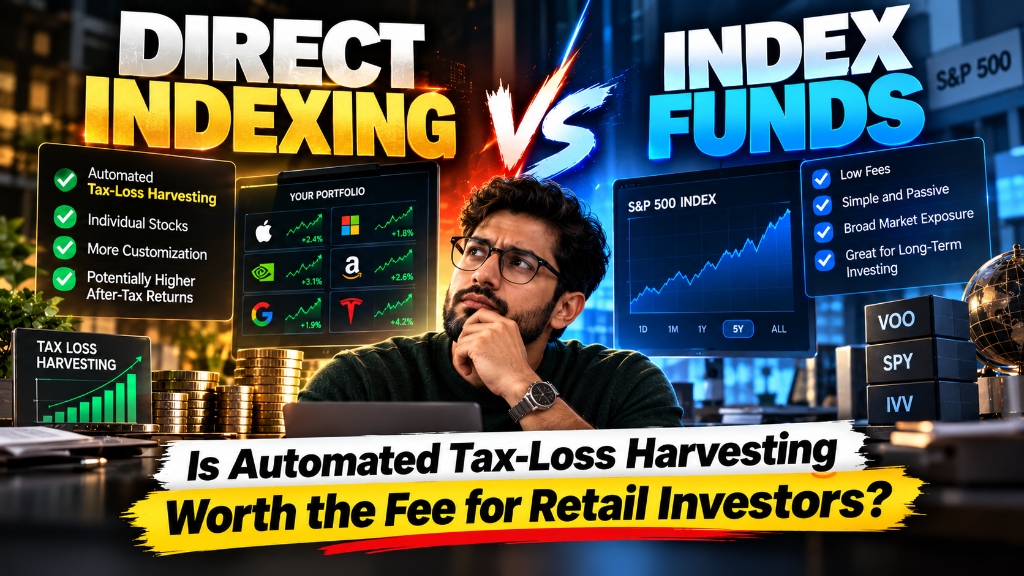
Direct Indexing vs. Index Funds: Is Automated Tax-Loss Harvesting Worth the Fee for Retail Investors?
Compare direct indexing vs index funds tax loss harvesting math. Uncover advisory fee drag, tax alpha decay, account minimums, and tracking error risks.
Educational Resource: This guide does not constitute financial or legal counsel.
Direct Answer: Direct indexing provides superior tax-loss harvesting by allowing you to own individual equities rather than an ETF wrapper, capturing individual stock losses even when broader market indexes climb. However, for most retail investors, the ongoing 0.20% to 0.40% management fee quickly overwhelms this tax alpha over time as your cost basis matures and loss-harvesting opportunities naturally decay.
For decades, low-cost broad-market index funds (such as Vanguard’s VTI or Schwab’s SCHB) were hailed as the undisputed gold standard for retail investing.
With expense ratios hovering near 0.03%, guaranteed market returns, and effortless portfolio maintenance, beating standard index ETFs seemed mathematically impossible.
Yet today, Wall Street brokerage giants like Fidelity, Charles Schwab, and Vanguard are heavily marketing a new alternative: Direct Indexing.
Brokers promise that by disaggregating an index and buying fractional shares of hundreds of individual stocks directly inside a taxable account, algorithms can harvest micro-losses every single trading day. This automated harvesting is said to generate “tax alpha”: offsetting external capital gains and putting more cash back in your pocket.
However, running a rigorous comparison of direct indexing vs index funds tax loss harvesting reveals a critical catch: that promised tax alpha comes bundled with a recurring 0.20% to 0.40% management fee, tracking error risk, and a five-year lock-in problem that few advisors warn you about.
Here is the objective breakdown of how direct indexing actually works, when it creates genuine tax alpha, and when it is simply an expensive way to recreate what cheap ETFs already do.
Direct Indexing 101: Owning Hundreds of Individual Stocks Instead of a Single ETF
Direct indexing is an investment strategy where an investor directly owns the individual fractional shares comprising an index rather than purchasing shares of a mutual fund or exchange-traded fund (ETF).
When you purchase an ETF like VOO (tracking the S&P 500), you own a single ticker symbol. If 150 companies inside the S&P 500 suffer catastrophic 20% drops while the remaining 350 companies rise by 15%, the overall ETF finishes the year up 8%.
Because the fund rose in aggregate, you cannot harvest a single dollar of tax loss on your winning ETF position.
- Standard ETF Structure: 500 companies held inside one single wrapper. If the index ends +8% up overall, zero tax losses are available to harvest.
- Direct Indexing Structure: 500 individual fractional stocks held directly in your account. You can harvest losses on the 150 declining stocks, locking in tax offsets even while the broader market climbs.
With direct indexing, you do not own the wrapper: you own all 500 individual corporate equities directly in your brokerage account. When those 150 specific companies drop in value, the software automatically sells those losing positions, instantly locks in the capital loss, and reinvests the proceeds into highly correlated alternative stocks to maintain your target market exposure while dodging the IRS 30-day Wash Sale Rule.
How Micro-Level Tax Loss Harvesting Generates “Tax Alpha” During Flat Markets
Direct indexing generates tax alpha by continuously monetizing daily stock-level volatility to offset realized capital gains from real estate, business exits, or high salaries.
Under federal tax law, realized capital losses can offset an unlimited amount of realized capital gains in the same tax year. If your capital losses exceed your capital gains, you can use up to $3,000 of net losses to offset ordinary income, carrying forward any remaining balance indefinitely.
| Feature / Metric | Direct Indexing Portfolio | Broad-Market Index ETF (e.g., VTI) |
|---|---|---|
| Underlying Holdings | 200 to 500 individual fractional stocks | 1 single exchange-traded fund share |
| Tax-Loss Harvesting Granularity | Stock-by-stock, executed daily or weekly | Fund-level, executed only when the entire index drops |
| Typical Advisory Management Fee | 0.20% to 0.40% annually | 0.03% to 0.05% expense ratio |
| Tracking Error Risk | Moderate (0.5% to 1.5% deviation from benchmark) | Effectively zero (closely tracks index) |
| Customization & Tilts | High (exclude specific sectors, ESG filters, employer stock) | None (fixed index composition) |
| Portfolio Portability | Low (moving hundreds of fractional lots is cumbersome) | High (easily transferred between brokerages via ACATS) |
Consider a market environment where the broad S&P 500 moves sideways for an entire calendar year, ending up exactly 0.5%. An ETF investor realizes zero tax loss.
A direct indexing algorithm, however, actively harvests dips across individual volatile components (such as regional banks, biotechnology firms, or retail stocks), realizing $8,000 in gross capital losses on a $250,000 account. For an investor in the highest federal and state capital gains bracket (paying 23.8% federal plus 10% state tax), that $8,000 loss saves roughly $2,704 in actual taxes, creating positive tax alpha for that year.
The Fee Drag: Comparing a 0.35% Advisory Fee Against a 0.03% Broad Market ETF
A 0.35% annual management fee creates a persistent performance drag that compounds against your portfolio balance regardless of whether the strategy produces tax losses.
To determine if direct indexing is worth the expense, you must measure the gross tax alpha against the net advisory fee. Most retail direct indexing accounts (offered by platforms like Fidelity Managed FidFolios, Schwab Personalized Indexing, and Vanguard Personalized Indexing) charge an annual management fee between 0.25% and 0.40%.
Let’s model the impact of a 0.35% direct indexing fee versus a 0.03% Vanguard ETF on a $500,000 portfolio compounding at 8% gross return over 20 years:
- Portfolio A (Index ETF at 0.03% Fee): Grows to approximately $2,311,000.
- Portfolio B (Direct Indexing at 0.35% Fee): Grows to approximately $2,178,000.
- The Compounding Cost: That seemingly tiny 0.32% fee differential costs the investor more than $133,000 in lost wealth.
For direct indexing to justify that $133,000 fee drag, the software must harvest enough realized tax savings every single year to consistently beat that hurdle rate.
The 5-Year Lock-In Trap: What Happens When Your Cost Basis Depletes
The tax-harvesting effectiveness of direct indexing decays dramatically after three to seven years as all individual stock positions accumulate substantial embedded gains.
This decay is the biggest industry secret in retail wealth management. Tax-loss harvesting relies entirely on the presence of unrealized losses. When you first fund a direct indexing account with new cash, 100% of your holdings have zero gains, meaning every market dip creates an immediate tax loss.
- Years 1 to 3 (High Tax Alpha): Many stock lots remain near or below cost basis, unlocking rapid, high-volume loss harvesting.
- Years 4 to 7 (Maturing Portfolio): More than 80% of stocks accumulate large embedded gains, causing loss-harvesting opportunities to dwindle.
- Year 8 and Beyond (Tax Alpha Decay): Near-zero tax losses remain to harvest, yet the investor continues paying the recurring 0.35% annual management fee.
After five to ten years of standard market compounding, historical stock market appreciation pushes nearly every company in your account far above its original purchase price. Even if a stock plunges 20% in a bad year, if it had previously appreciated 150%, selling it results in a taxable capital gain, not a harvestable loss.
At this stage, you face the Lock-In Trap:
- You can no longer harvest losses to offset taxes.
- The brokerage continues billing you 0.35% every year on your inflated account balance.
- You cannot easily switch back to simple ETFs without liquidating hundreds of stock lots, which would trigger massive capital gains taxes.
The only way to sustain tax-loss harvesting over multiple decades is to continuously inject massive amounts of fresh, uninvested cash into the account every single year.
Minimum Capital Requirements Across Major Brokerages
Retail brokerages have lowered minimum investment thresholds through fractional trading, but account scale still dictates the real-world value of direct indexing.
| Brokerage / Platform | Minimum Investment | Advisory / Management Fee | Benchmark Universe |
|---|---|---|---|
| Fidelity Managed FidFolios | $5,000 | 0.40% annually | US Large Cap, International, Environmental Tilts |
| Schwab Personalized Indexing | $100,000 | 0.40% annually | Schwab 1000, US Large Cap, Small Cap |
| Vanguard Personalized Indexing | $100,000 ($250k for full custom) | 0.20% to 0.35% tiered | Russell 1000, S&P 500, Custom Factor Blends |
| Parametric (Morgan Stanley) | $250,000 | 0.30% to 0.50% (advisor required) | Custom Institutional Multi-Asset Indexes |
While Fidelity allows investors to start with as little as $5,000, running direct indexing on small balances makes zero mathematical sense. A $5,000 balance generating $150 in tax losses saves a modest $30 to $45 in taxes: hardly worth the complexity of filing dozens of pages of IRS Form 8949 transactions on your annual tax return.
Scorecard: Who Genuinely Benefits (and Who Should Stick to Simple ETFs)
Direct indexing is a specialized tax-arbitrage vehicle designed for specific, high-bracket financial situations, not a blanket replacement for index funds.
Who Truly Wins with Direct Indexing:
- Founders and Executives with Concentrated Stock: If you hold $1,000,000 of company stock from an employer IPO or grant, direct indexing allows you to construct a portfolio that specifically excludes your employer while aggressively harvesting losses across other sectors to offset your planned stock sales.
- Active Investors with Large, Recurring Capital Gains: If you reliably realize hundreds of thousands in short-term capital gains each year from real estate developments, private equity distributions, or hedge fund allocations, the harvested losses directly shield high-bracket income.
- Continuous High-Income Savers: Professionals injecting $10,000+ of new cash into taxable accounts every single month consistently reset their cost basis, extending the tax-harvesting window.
Who Should Stick to Broad-Market Index ETFs:
- Long-Term Buy-and-Hold Accumulators: If your primary investing strategy is dollar-cost averaging into taxable accounts and letting it sit untouched for 30 years, low-cost ETFs like VTI or VOO will easily beat direct indexing after fees.
- Investors in Low to Moderate Tax Brackets: If your federal capital gains rate is 0% or 15%, the tax savings generated by harvesting are too small to offset advisory fees.
- Simplicity Enthusiasts: If you do not want an 80-page 1099-B tax document detailing 1,200 micro-transactions every spring, keep your financial life clean with standard ETFs.
Frequently Asked Questions
Is direct indexing worth it for high income earners?
Direct indexing is worth it for high-income earners who consistently realize large external capital gains from business sales or real estate, but only during the first five to seven years before the portfolio basis becomes fully appreciated.
What is the difference between direct indexing and robo-advisor tax-loss harvesting?
Robo-advisors (such as Betterment or Wealthfront) harvest tax losses at the ETF level by swapping one fund for a correlated alternative (like swapping VTI for SCHB), whereas direct indexing harvests losses at the individual stock level across hundreds of fractional equity positions.
Does direct indexing create tracking error compared to the benchmark index?
Yes, direct indexing introduces tracking error because whenever the software harvests a losing stock and buys a replacement or holds cash temporarily, your portfolio deviates slightly from the exact underlying index returns.
What happens to a direct indexing account if I fire my advisor or cancel the service?
If you cancel a direct indexing service, you do not lose your stocks: the brokerage simply stops trading them and leaves you holding hundreds of individual fractional equity positions inside your account, which you must either manage manually or liquidate.
Does the IRS Wash Sale Rule apply to direct indexing?
Yes, the 30-day IRS Wash Sale Rule applies to direct indexing, which is why algorithms automatically swap sold losing stocks for “correlated but substantially non-identical” alternative companies to maintain sector balance without violating IRS guidelines.
Final Thoughts: Look Past Wall Street’s Latest Wrapper
Direct indexing is not financial magic: it is an algorithmic tax management tool wrapped in a fee structure that Wall Street brokerages love because it replaces zero-revenue index funds with recurring 0.35% advisory fees.
For the right investor with high recurring capital gains and concentrated corporate stock, the tax alpha can easily justify the management cost.
For the vast majority of disciplined retail wealth builders, however, the math remains unchanged. Running a rigorous direct indexing vs index funds tax loss harvesting evaluation proves that keeping your portfolio in simple, 0.03% broad-market ETFs, avoiding advisory fee drag, and holding through market volatility remains the most reliable path to lasting wealth.
Download: The 2026 Wealth Compounding & FIRE Planning Toolkit
Our complete spreadsheet model and 28-page strategic handbook covering asset allocation buckets, Indian inflation adjustments, and long-term SIP compounding.
- Interactive FIRE & Net Worth Excel/Sheets model
- Asset allocation & emergency reserve matrix
This article and its associated calculators are for educational and informational purposes only and do not constitute financial, investment, legal, tax, or medical advice. We may earn an affiliate commission on third-party links at zero cost to you. Always consult a licensed professional before making major financial, health, or investment decisions. Read our full Legal & Financial Disclaimer.
Aditya Singhania
Verified AuthorAditya writes about investing, saving habits, and smart money management. With a background in financial planning, he helps readers build simple, reliable wealth habits for the long run.
Was this essay valuable to you?
Help us refine our editorial focus and research priorities.
Reader Discussion (2)
Extremely well-articulated analysis on capital compounding. The breakdown on equity allocation vs active income is spot on.
The distinction between looking rich and building real moats is something more founders need to study deeply.
Explore Eternity Empire
Search empirical insights, explore our four wisdom categories, and discover curated strategic essays.
Search Insights
Recent Essays
The Backyard Cash Flow Engine: How to House Hack with an ADU in 2026
11 min read • Oct 20How to Become a Fractional COO: Landing Your First $5,000/Month Retainer Client
12 min read • Oct 20The Zero-Bounce Outbound Engine: How to Set Up Multi-Domain Cold Email with Instantly and Clay
12 min read • Oct 20Featured Guides
Further Wisdom & Insights
Explore All Articles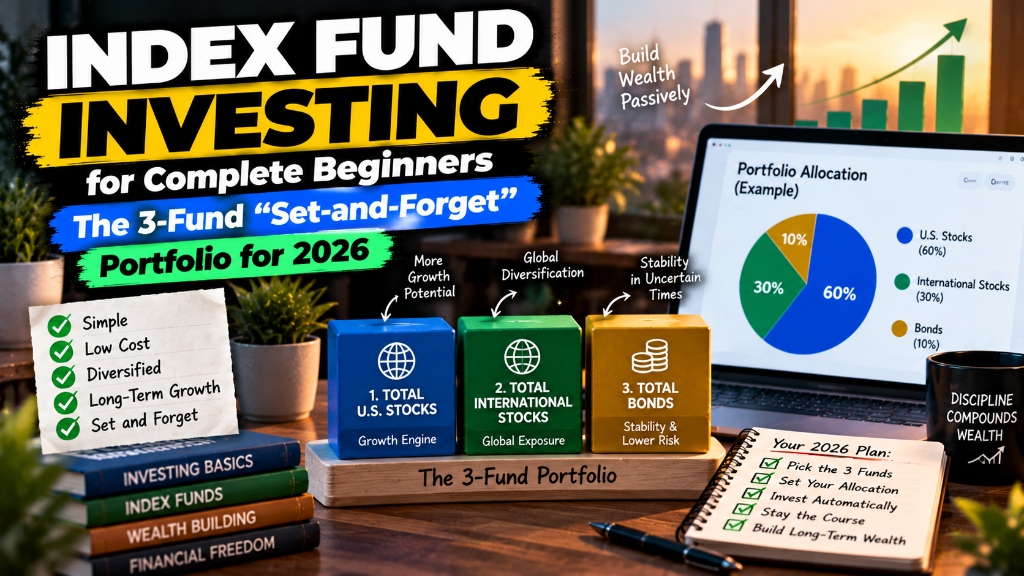
Index Fund Investing for Beginners: The 3-Fund Portfolio (2026)
Master index fund investing with the simple 3-fund portfolio in 2026. Learn exact Vanguard, Fidelity, and Schwab tickers, age allocations, and tax placement.
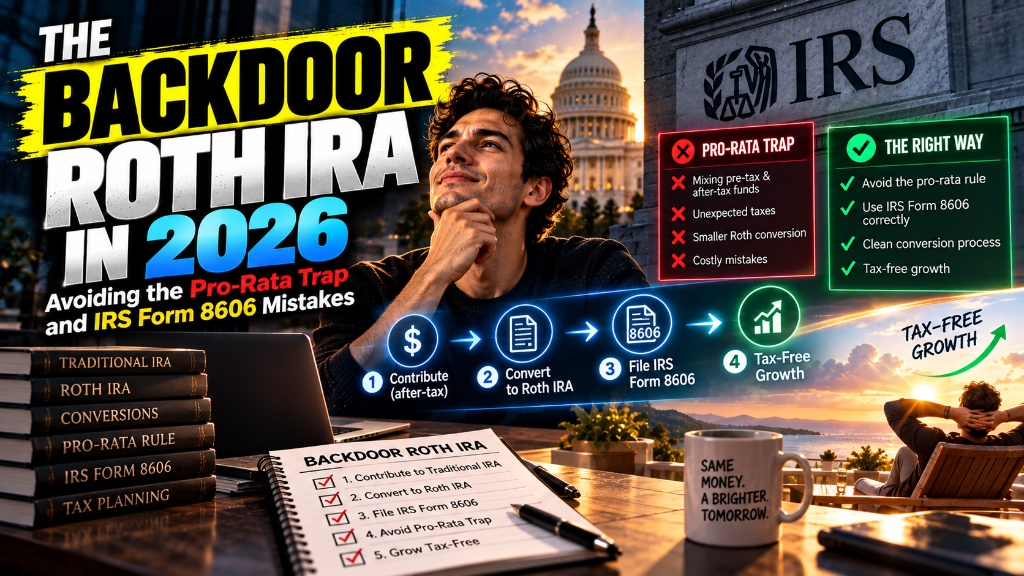
The Backdoor Roth IRA in 2026: Avoiding the Pro-Rata Trap and IRS Form 8606 Mistakes
Master the backdoor Roth pro rata rule guide 2026. Avoid surprise tax penalties, execute reverse rollovers into 401(k)s, and master IRS Form 8606 line by line.
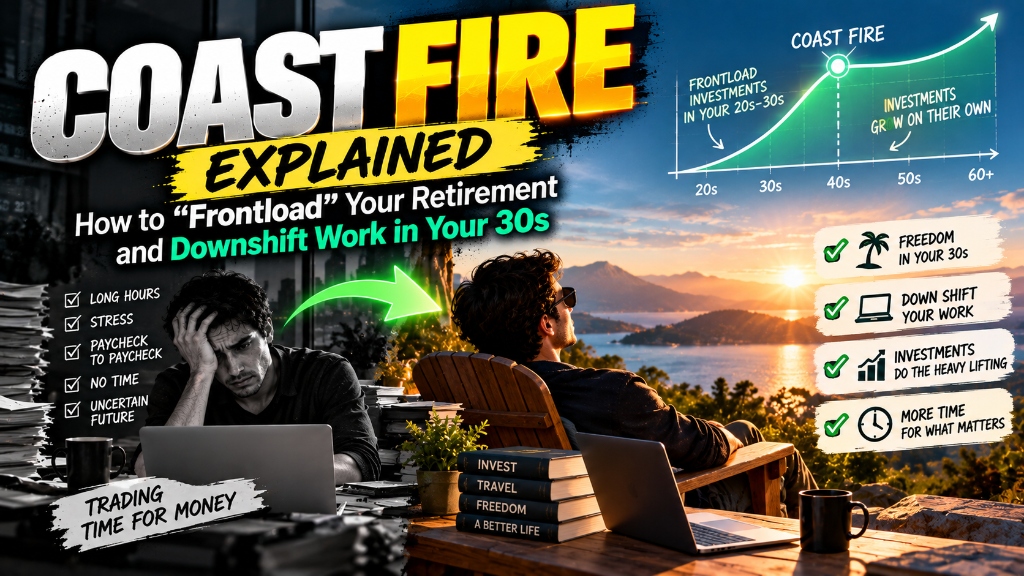
Coast FIRE Explained: How to Frontload Retirement and Downshift Work in Your 30s
Master the Coast FIRE calculator and milestone strategy. Learn the exact math to frontload retirement savings and downshift into low-stress work in your 30s.