

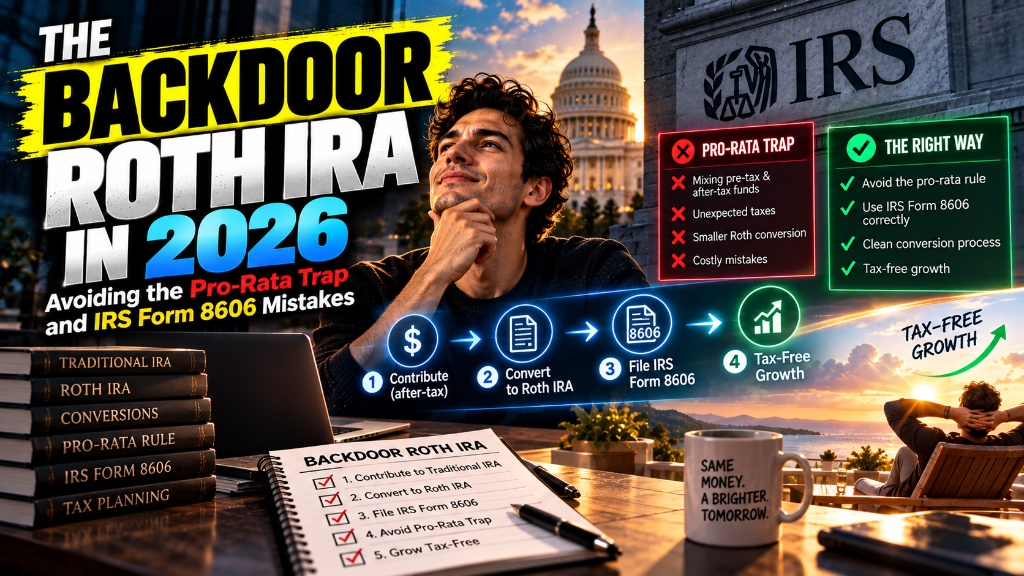
The Backdoor Roth IRA in 2026: Avoiding the Pro-Rata Trap and IRS Form 8606 Mistakes
Master the backdoor Roth pro rata rule guide 2026. Avoid surprise tax penalties, execute reverse rollovers into 401(k)s, and master IRS Form 8606 line by line.
Educational Resource: This guide does not constitute financial or legal counsel.
Direct Answer: The backdoor Roth pro rata rule guide for 2026 shows high earners how to convert non-deductible Traditional IRA funds into a Roth IRA without triggering unexpected income taxes. Under IRS aggregation rules, if you hold pre-tax balances in any Traditional, SEP, or SIMPLE IRA on December 31, conversions are taxed proportionally across all accounts unless neutralized through a 401(k) reverse rollover.
Earning a high income is an undeniable financial milestone, but it quickly locks you out of some of the tax code’s most valuable wealth-building perks.
Once your Modified Adjusted Gross Income (MAGI) crosses federal statutory thresholds, the IRS legally bans you from contributing directly to a standard Roth IRA. For corporate managers, physicians, software engineers, and successful entrepreneurs, this rule threatens to cut off decades of tax-free investment compounding.
Fortunately, Congress left the front door locked while leaving the back door wide open.
Through the Backdoor Roth IRA strategy, anyone can contribute after-tax money to a Traditional IRA and immediately convert it to a Roth IRA, regardless of income.
However, thousands of high-earning professionals bungle this process every year. They fail to understand the dreaded IRS Pro-Rata Rule, triggering massive, unnecessary tax bills and confusing their tax preparers with botched Form 8606 filings.
Here is the comprehensive guide to executing a clean, tax-free Backdoor Roth IRA in 2026, eliminating pre-tax IRA balances, and filing your tax forms with complete confidence.
Income Limits for 2026: Why High Earners Must Use the Backdoor Strategy
IRS income limits completely prohibit direct Roth IRA contributions once an individual or married couple crosses the annual Modified Adjusted Gross Income phase-out range.
For the 2026 tax year, the IRS establishes strict contribution barriers:
- Single Filers: The phase-out range begins at approximately $150,000 and cuts off completely at $165,000 MAGI. If your income exceeds $165,000, your direct Roth IRA contribution limit is exactly zero dollars.
- Married Filing Jointly: The phase-out begins at $236,000 and terminates at $246,000 MAGI. Earn one dollar above the ceiling, and you cannot make a direct deposit.
While the tax code blocks contributions to a Roth IRA based on income, the Tax Increase Prevention and Reconciliation Act of 2005 permanently eliminated all income restrictions on Roth conversions. This deliberate statutory distinction created the legal foundation for the Backdoor Roth: you fund a Traditional IRA (which has zero income limits on non-deductible deposits) and immediately convert that money into your Roth IRA.
The Pro-Rata Rule Explained: The Aggregate IRA Balance Calculation
The IRS pro-rata rule mandates that when you convert IRA funds to a Roth, the IRS views all your non-Roth IRAs as a single collective pool, taxing conversions proportionately.
You cannot cherry-pick which specific dollars you convert. Under Internal Revenue Code Section 408(d)(2), the IRS requires you to aggregate all your pre-tax IRA accounts as of December 31 of the conversion year. This aggregate balance includes:
- Traditional IRAs
- Rollover IRAs (from previous employer 401(k) plans)
- SEP IRAs (Simplified Employee Pension)
- SIMPLE IRAs
The Pro-Rata Mathematical Trap
Imagine an investor named Sarah who holds $93,000 in a Rollover IRA from an old corporate job (all 100% pre-tax dollars). Sarah decides to do a Backdoor Roth in 2026:
- She deposits $7,000 of post-tax cash into a new Traditional IRA.
- Her total aggregate IRA balance across all accounts is now $100,000 ($93,000 pre-tax + $7,000 post-tax).
- She converts $7,000 to her Roth IRA, assuming she is converting her post-tax money.
Under the Pro-Rata Rule, the IRS calculates the tax-free ratio:
Tax-Free Ratio = Post-Tax Basis / Total Aggregate IRA Balance = $7,000 / $100,000 = 7%
This means that only 7% of her $7,000 conversion ($490) is tax-free. The remaining 93% ($6,510) is treated as taxable ordinary income. At a 35% federal and state tax bracket, Sarah unexpectedly owes $2,278 in taxes on money she thought was already taxed.
The “Reverse Rollover” Fix: Moving Pre-Tax IRA Dollars into an Employer 401(k)
The reverse rollover fix neutralizes the pro-rata rule by transferring all pre-tax Traditional and Rollover IRA balances into an active employer 401(k) or Solo 401(k).
The IRS Pro-Rata aggregation rule applies strictly to IRAs: it completely ignores employer-sponsored qualified retirement plans, including:
- Employer 401(k) and 403(b) plans
- Government 457(b) plans
- Solo 401(k) plans for self-employed individuals
If you have pre-tax money sitting in a Traditional or Rollover IRA, contact your current employer’s 401(k) plan administrator (such as Fidelity, Empower, or Vanguard) and ask: “Does our 401(k) plan accept incoming roll-ins of pre-tax IRA assets?”
Most corporate plans allow this. By executing a Reverse Rollover to transfer your $93,000 pre-tax balance into your employer’s 401(k) before December 31 of the tax year, your aggregate Traditional IRA balance drops to exactly $0.00.
With an aggregate pre-tax balance of zero, your $7,000 Backdoor Roth conversion is 100% non-taxable.
The 3-Step Execution Tutorial (Non-Deductible Contribution to Settlement to Roth Conversion)
Executing a clean Backdoor Roth requires contributing post-tax cash, letting the funds settle in money market cash, and converting the full balance immediately.
To complete the transaction seamlessly on any major brokerage, follow this exact sequence:
Step 1: Fund the Traditional IRA
Log into your brokerage and transfer $7,000 (or the current annual maximum) from your linked checking account into your Traditional IRA.
- Critical Action: Select
Current Year Contribution. Leave the cash sitting uninvested in the core settlement fund (such as SPAXX at Fidelity or VMFXX at Vanguard). Do not purchase stocks or mutual funds inside the Traditional IRA.
Step 2: Wait for Cash Settlement (1 to 3 Business Days)
Wait until the electronic bank transfer fully clears and displays as Cash Available to Withdraw/Convert. If you attempt to convert before the bank funds settle, the platform will decline the transfer.
Step 3: Execute the Roth Conversion
Click on Transfers and select Convert to Roth IRA.
- Choose
Convert 100% of the account balance. - Select
Do Not Withhold Taxes(withholding taxes from the conversion is a critical error that triggers an IRS early distribution penalty on the withheld sum). - Complete the transfer. Once the funds arrive in your Roth IRA, invest the $7,000 immediately into your preferred long-term index funds (like VOO, VTI, or an S&P 500 index fund).
Comparison Table: Standard Roth IRA vs. Backdoor Roth vs. Mega-Backdoor Roth
| Retirement Vehicle | Annual Limit (2026) | Income Limit Restriction | Primary Tax Benefit | Complexity Level |
|---|---|---|---|---|
| Standard Roth IRA | $7,000 ($8,000 if 50+) | Phase-out over $150k / $236k | Tax-free growth and withdrawals | Very Low (Direct deposit) |
| Backdoor Roth IRA | $7,000 ($8,000 if 50+) | None (Unlimited income) | Tax-free growth and withdrawals | Moderate (Form 8606 required) |
| Mega-Backdoor Roth | Up to $46,000+ extra via 401(k) | None (Depends on employer plan) | Massive tax-free retirement vault | High (Requires plan sponsor support) |
How to Fill Out IRS Form 8606 Accurately (Line-by-Line Guide)
IRS Form 8606 is the mandatory tax document used to report non-deductible IRA contributions and track after-tax basis so you are never double-taxed.
Failing to submit Form 8606 with your annual Form 1040 leads the IRS to assume your Traditional IRA contribution was deducted from your income, prompting an erroneous deficiency notice.
Here is how a clean Form 8606 looks when you contribute $7,000 and convert $7,000 with zero pre-tax balance:
Part I: Nondeductible Contributions
- Line 1: Enter
$7,000(Your non-deductible contribution for the tax year). - Line 2: Enter
$0(Your total basis in Traditional IRAs from prior years). - Line 3: Add Line 1 and Line 2 =
$7,000. - Line 4: Enter
$0(Unless you made contributions between Jan 1 and April 15 of the following year). - Line 5: Subtract Line 4 from Line 3 =
$7,000.
Calculating the Taxable Amount
- Line 6: Enter
$0(The total value of all Traditional, SEP, and SIMPLE IRAs as of December 31 of the tax year). - Line 7: Enter
$0(Net distributions from Traditional IRAs that were not converted). - Line 8: Enter
$7,000(The net amount converted to Roth IRA). - Line 9: Add Lines 6, 7, and 8 =
$7,000. - Line 10: Divide Line 5 by Line 9 =
1.000(Your non-taxable decimal ratio). - Line 11: Multiply Line 8 by Line 10 =
$7,000(Non-taxable portion of conversion). - Line 12: Enter
$0. - Line 13: Add Lines 11 and 12 =
$7,000. - Line 14: Subtract Line 13 from Line 3 =
$0(Your remaining basis in Traditional IRAs). - Line 15c: Subtract Line 11 from Line 8 =
$0(Taxable Amount of Conversion).
Filing Line 15c as $0 confirms to the IRS that your entire conversion was completely free of income tax.
Platform Walkthroughs: Executing Conversions on Vanguard, Schwab, and Fidelity
Discount brokerages have streamlined the backdoor conversion workflow into automated, self-serve web portals.
Fidelity Investments
Fidelity offers one of the smoothest backdoor workflows:
- Deposit cash into your Traditional IRA.
- Wait two days for cash to show under
Available to Withdraw. - Go to
Accounts & Trade > Transfer. Choose From:Traditional IRATo:Roth IRA. - Fidelity detects the conversion and prompts: “This is a Roth conversion.” Select
Convert all of itand selectDo not withhold taxes.
Charles Schwab
Schwab’s interface handles conversions smoothly:
- Fund the Traditional IRA via electronic bank transfer.
- Navigate to
Move Money > Transfers & Payments. - Choose your Traditional IRA as the source and Roth IRA as the destination.
- Select
Entire Balanceand toggleDo not withhold federal or state taxes.
Vanguard
Vanguard’s modern portal automates basis reporting:
- Go to
Transfers > Transfer money. - Select transfer from
Vanguard Traditional IRAtoVanguard Roth IRA. - Under step two, check the option: “Convert 100% of the balance.”
- Confirm tax withholding preference is set to 0% and submit.
Frequently Asked Questions
What happens if my money earns $1 or $2 of interest while waiting to convert?
If your $7,000 contribution earns $1 or $2 of interest in the settlement fund before converting, simply convert the entire balance ($7,002). You will pay ordinary income tax on that $2 of earnings (roughly 70 cents), but the conversion remains 100% valid and avoids leaving stray pennies behind.
How does the pro-rata rule work with a SEP IRA?
The IRS includes SEP IRAs and SIMPLE IRAs in the aggregate IRA calculation. If you hold a pre-tax SEP IRA from freelance work, you must either roll it into an employer 401(k) / Solo 401(k) or convert the SEP balance to a Roth before doing a Backdoor Roth.
Can both spouses do a Backdoor Roth IRA each year?
Yes, IRAs are individual accounts. Even if one spouse does not earn income, a married couple filing jointly can fund two separate Backdoor Roth IRAs (using the Spousal IRA rule), shielding $14,000+ of annual investments from future taxes.
Is there a waiting period between contributing and converting?
No, the IRS eliminated the “step-transaction doctrine” concern for Backdoor Roth conversions in 2018. You can convert immediately after your cash deposit settles, which typically takes one to two business days.
What if I forgot to file Form 8606 in past years?
If you forgot to file Form 8606 for past non-deductible contributions, you can file standalone Forms 8606 retroactively for each missed year. The IRS assesses a nominal $50 penalty for late filings, but rarely enforces it if filed voluntarily before an audit notice.
Final Thoughts: Protect Your Future Purchasing Power
Compounding investment returns without the drag of dividend taxes and capital gains taxes is one of the greatest mathematical advantages available to wealth builders.
Do not let high earnings prevent you from taking advantage of a Roth IRA. By executing the Backdoor Roth systematically, clearing out pre-tax IRA accounts with reverse rollovers, and reporting your basis accurately on Form 8606, you build a multi-million-dollar tax-free asset that pays dividends for decades.
Review your IRA account balances today, eliminate any lingering pre-tax funds, and complete your Backdoor Roth conversion before the tax year closes.
Download: The 2026 Wealth Compounding & FIRE Planning Toolkit
Our complete spreadsheet model and 28-page strategic handbook covering asset allocation buckets, Indian inflation adjustments, and long-term SIP compounding.
- Interactive FIRE & Net Worth Excel/Sheets model
- Asset allocation & emergency reserve matrix
This article and its associated calculators are for educational and informational purposes only and do not constitute financial, investment, legal, tax, or medical advice. We may earn an affiliate commission on third-party links at zero cost to you. Always consult a licensed professional before making major financial, health, or investment decisions. Read our full Legal & Financial Disclaimer.
Aditya Singhania
Verified AuthorAditya writes about investing, saving habits, and smart money management. With a background in financial planning, he helps readers build simple, reliable wealth habits for the long run.
Was this essay valuable to you?
Help us refine our editorial focus and research priorities.
Reader Discussion (2)
Extremely well-articulated analysis on capital compounding. The breakdown on equity allocation vs active income is spot on.
The distinction between looking rich and building real moats is something more founders need to study deeply.
Explore Eternity Empire
Search empirical insights, explore our four wisdom categories, and discover curated strategic essays.
Search Insights
Recent Essays
The Backyard Cash Flow Engine: How to House Hack with an ADU in 2026
11 min read • Oct 20How to Become a Fractional COO: Landing Your First $5,000/Month Retainer Client
12 min read • Oct 20The Zero-Bounce Outbound Engine: How to Set Up Multi-Domain Cold Email with Instantly and Clay
12 min read • Oct 20Featured Guides
Further Wisdom & Insights
Explore All Articles
Direct Indexing vs. Index Funds: Is Automated Tax-Loss Harvesting Worth the Fee for Retail Investors?
Compare direct indexing vs index funds tax loss harvesting math. Uncover advisory fee drag, tax alpha decay, account minimums, and tracking error risks.

Coast FIRE Explained: How to Frontload Retirement and Downshift Work in Your 30s
Master the Coast FIRE calculator and milestone strategy. Learn the exact math to frontload retirement savings and downshift into low-stress work in your 30s.

The HSA Shoebox Strategy: How to Turn a Health Savings Account into a Tax-Free Stealth IRA
Master the HSA shoebox strategy to turn healthcare savings into a tax-free stealth IRA. Learn delayed reimbursement rules, record-keeping, and custodian picks.