

How to Build a 4-Week T-Bill Ladder on TreasuryDirect (Step-by-Step)
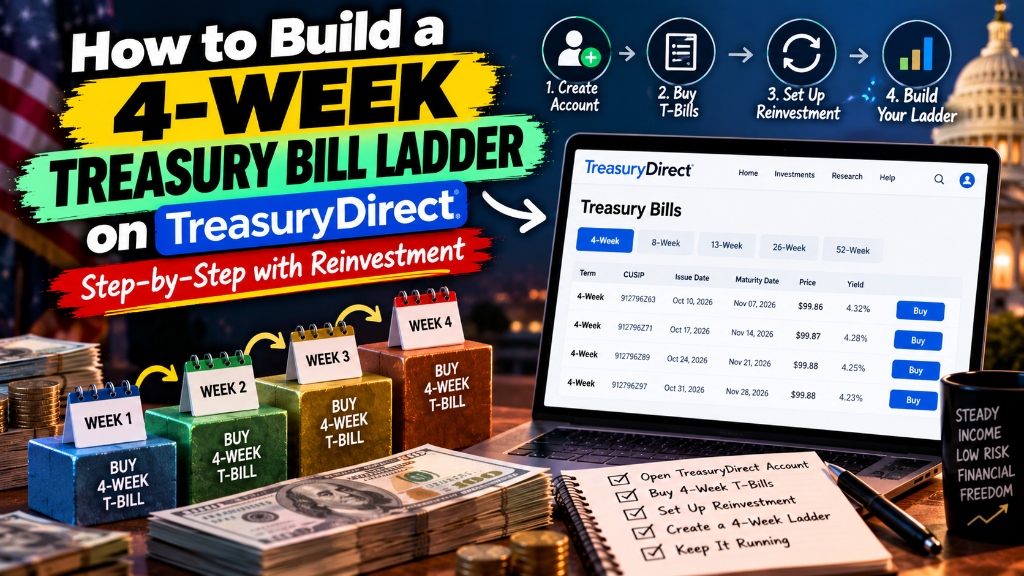
Learn how to build a 4-week Treasury bill ladder on TreasuryDirect. Maximize state-tax-exempt yields, automate reinvestments, and preserve weekly cash liquidity.
Educational Resource: This guide does not constitute financial or legal counsel.
Building a 4-week Treasury bill ladder involves dividing your liquid cash into four equal tranches and purchasing short-term US sovereign debt securities staggered across four consecutive weekly auctions. By turning on TreasuryDirect’s automatic reinvestment feature, one tranche matures every seven days, providing continuous liquidity, top-tier capital preservation, and complete exemption from state and local income taxes.
Leaving large cash reserves sitting in standard commercial bank accounts often means accepting subpar interest yields or navigating frustrating balance caps.
Even High-Yield Savings Accounts (HYSAs), while convenient, carry a major hidden cost for high-earning professionals: every dollar of interest earned is fully taxable at federal, state, and local income tax rates. In high-tax jurisdictions like California, New York, New Jersey, or Massachusetts, state taxes can devour up to 10% to 13% of your nominal interest return, significantly eroding your real purchasing power after inflation.
United States Treasury bills (T-bills) solve both problems simultaneously. Backed by the full faith and credit of the US government, short-term T-bills are free from state and local taxes while offering competitive, sovereign-grade risk-free yields.
However, locking up all your cash into a single fixed maturity date creates liquidity risk. By learning how to build a t-bill ladder with 4-week durations, you capture peak short-term yields while ensuring a fresh stream of cash unlocks every single week. Here is the step-by-step walkthrough to set up, automate, and manage your ladder directly through TreasuryDirect.
What Is a T-Bill Ladder and Why Build One Today?
A Treasury bill ladder is an investment strategy that divides cash across multiple maturity dates so that bonds mature at regular, predictable intervals.
Treasury bills are short-term government debt obligations sold at a discount to their face value (par value of $100). When the bill matures, the Treasury pays you the full face value, with the difference representing your earned interest. They are issued in durations of 4, 8, 13, 17, 26, and 52 weeks.
In a rolling 4-week ladder, you divide your target cash pool into four equal portions:
| Tranche | Purchase Schedule | Capital Allocation | Maturity Schedule | Auto-Reinvestment Status |
|---|---|---|---|---|
| Tranche 1 | Week 1 (Thursday) | $5,000 | Matures Week 5 | Enabled (24 cycles) |
| Tranche 2 | Week 2 (Thursday) | $5,000 | Matures Week 6 | Enabled (24 cycles) |
| Tranche 3 | Week 3 (Thursday) | $5,000 | Matures Week 7 | Enabled (24 cycles) |
| Tranche 4 | Week 4 (Thursday) | $5,000 | Matures Week 8 | Enabled (24 cycles) |
(Result: From Week 5 onward, a $5,000 tranche matures every week, delivering continuous liquidity).
This structure gives you three decisive benefits:
- Continuous Liquidity: 25% of your total principal becomes fully liquid every seven days. You are never more than a few days away from penalty-free cash.
- Interest Rate Responsiveness: As market interest rates shift, your maturing tranches continuously reinvest at the most recent auction yields.
- Zero Credit Risk: Unlike corporate commercial paper or bank deposits that exceed standard FDIC insurance limits ($250,000 per depositor), T-bills are backed directly by the US Department of the Treasury.
The Tax Advantage: State and Local Tax Exemptions Explained
Under federal law (31 U.S.C. Section 3124), interest earned on United States Treasury obligations is 100% exempt from all state and local income taxes.
This exemption creates a substantial performance gap between Treasury bills and bank savings accounts or certificates of deposit (CDs). To accurately compare a state-tax-exempt T-bill against a taxable HYSA, you must calculate the Tax-Equivalent Yield (TEY):
Tax-Equivalent Yield (TEY) = T-Bill Nominal Yield / (1 − Marginal State Tax Rate)
For example, suppose a 4-week T-bill yields 4.60% nominal interest, while a high-yield savings account offers 4.75%. At first glance, the bank account looks superior.
However, look at what happens when you factor in state income taxes for residents in different states:
| Location | Marginal State Tax Rate | HYSA Nominal Yield (4.75%) | T-Bill Nominal Yield (4.60%) | T-Bill Tax-Equivalent Yield | Real Winner |
|---|---|---|---|---|---|
| Texas / Florida / Washington | 0.0% | 4.75% | 4.60% | 4.60% | HYSA (by 0.15%) |
| Illinois | 4.95% | 4.75% | 4.60% | 4.84% | T-Bill (+0.09%) |
| New York State + NYC | 10.5% | 4.75% | 4.60% | 5.14% | T-Bill (+0.39%) |
| California | 12.3% | 4.75% | 4.60% | 5.25% | T-Bill (+0.50%) |
For an investor in New York City or California holding $100,000 in cash, that 0.50% tax-equivalent advantage preserves $500 in pure cash every single year, with zero additional risk.
[!NOTE] At year-end, your TreasuryDirect account issues a Form 1099-INT. The interest appears in Box 3 (“Interest on U.S. Savings Bonds and Treas. Obligations”), which flows onto your state tax return as an exclusion from state taxable income.
Navigating TreasuryDirect: Account Setup and Security Without Friction
TreasuryDirect is the official portal of the US Department of the Treasury that allows individual investors to purchase government bonds directly without brokerage commissions.
While the platform has a dated aesthetic and strict login security controls, setting up an individual account takes about 10 minutes if you have the required documents on hand.
Account Creation Checklist
- Taxpayer Identification: Social Security Number (SSN) or Employer Identification Number (EIN).
- Physical Address: A valid US residential or business address (P.O. Boxes are not permitted).
- Linked Checking Account: Routing number and account number for the bank account used to fund purchases and receive redemptions.
Security Best Practices on TreasuryDirect
- Store Your Account Number Carefully: TreasuryDirect generates a unique account number starting with a letter followed by nine digits (e.g.,
A-123-456-789). You must use this number to log in; your email address cannot be used as a username. - Virtual Keyboard Password Entry: The platform historically required entering passwords via an on-screen clickable keyboard. While modern browsers now support password managers, keep your master credentials securely backed up.
- One-Time Passcode (OTP): Every login sends a temporary verification passcode to your registered email address. Ensure your email security uses strong two-factor authentication.
Setting Up the 4-Week Auction Purchases and Auto-Reinvestment
Constructing your 4-week ladder requires scheduling four separate purchases staggered across four consecutive weekly auction cycles.
The US Treasury conducts 4-week T-bill auctions every week. Typically, 4-week bills are announced on Mondays, auctioned on Tuesdays, and issued (settled and funded) on Thursdays.
- Access TreasuryDirect: Log in and click “BuyDirect” in the top navigation bar.
- Select Security Type: Check the “Bills” radio button and click “Submit”.
- Choose Product Term: Select “4-Week” under Product Type.
- Enter Purchase Amount: Input your amount in $100 increments (e.g., $5,000).
- Set Issue Date: Choose the upcoming Thursday auction settlement date.
- Configure Auto-Reinvestment: Select “Yes” and designate the number of reinvestments (e.g., 12 or 24).
- Select Bank Account: Choose your linked checking account for funding.
- Review & Authorize: Verify your purchase confirmation and click “Submit”.
Repeat this exact purchase process once per week for four consecutive weeks:
- Week 1 (Thursday 1): Fund Tranche 1 ($5,000) with 24 reinvestments.
- Week 2 (Thursday 2): Fund Tranche 2 ($5,000) with 24 reinvestments.
- Week 3 (Thursday 3): Fund Tranche 3 ($5,000) with 24 reinvestments.
- Week 4 (Thursday 4): Fund Tranche 4 ($5,000) with 24 reinvestments.
Once Week 4 settles, your automated ladder is fully built. Every Thursday, one $5,000 bill reaches its maturity date. The system automatically rolls the principal into a brand-new 4-week bill at the prevailing auction rate, depositing any net discount interest directly into your linked bank checking account.
[!TIP] If you are setting aside cash reserves for future real estate down payments or business equity investments, calculate how compounding yields accelerate your timeline using our Eternity Empire Compounding Interest Calculator.
Unwinding or Modifying Your Ladder When Cash Is Needed
To extract cash from your TreasuryDirect ladder, you simply turn off automatic reinvestment for the next maturing tranche.
Because one tranche matures every seven days, you never need to sell a bill early on the secondary market or pay early withdrawal penalties like those found on bank CDs. You simply adjust the reinvestment setting online:
- Log in to your TreasuryDirect portal and click on ManageDirect in the top navigation menu.
- Under the “Manage My Securities” header, select Update reinvestment options.
- Choose the specific maturing 4-week bill scheduled for the upcoming Thursday.
- Change the reinvestment status from Yes to No.
- Click Submit.
On Thursday morning, the Treasury deposits the entire $5,000 face value directly into your linked commercial checking account via ACH transfer, completely free of fees. The remaining three tranches continue rolling over uninterrupted.
TreasuryDirect vs. Brokerage Ladders: Fidelity, Schwab, and Vanguard
You can build a T-bill ladder directly through TreasuryDirect or via major brokerage firms like Fidelity, Charles Schwab, and Vanguard.
| Feature / Criteria | TreasuryDirect Portal | Brokerage Platforms (Fidelity / Schwab) | Winner |
|---|---|---|---|
| Minimum Purchase | $100 | $1,000 (standard par unit) | TreasuryDirect (lower minimum) |
| Automated Rollovers | Up to 2 years (24 reinvestments) | Fidelity offers Auto-Roll; Schwab requires manual orders | TreasuryDirect & Fidelity |
| Secondary Market Selling | Cannot sell early; must transfer to broker | Can sell immediately on secondary market during trading hours | Brokerages (instant liquidity) |
| User Experience & UI | 1990s government interface | Modern, responsive mobile apps and web tools | Brokerages |
| Cash Consolidation | Isolated government account | Sits alongside your IRAs, stocks, and checking | Brokerages |
| State Tax Exemption | Automatic 1099-INT reporting | Automatic 1099-INT reporting | Tie |
If you already maintain an active investment portfolio at Fidelity or Charles Schwab, purchasing new-issue Treasury bills directly through your brokerage offers superior convenience and allows you to liquidate on the secondary market within hours if a sudden emergency strikes.
However, if you want an isolated cash vault dedicated to savings where you will not be tempted to gamble funds on volatile stocks, TreasuryDirect provides a rock-solid, distraction-free environment.
Frequently Asked Questions
Can I lose money investing in Treasury bills?
You cannot lose nominal principal on Treasury bills if you hold them to maturity, because they are backed by the full faith, credit, and taxing authority of the United States government. The only risk is opportunity cost: if inflation or interest rates rise significantly, your fixed yield may temporarily lag broader consumer price inflation.
What happens if TreasuryDirect auto-reinvestment ends after 24 cycles?
When your maximum 24 reinvestment cycles expire (approximately two years), the final principal is automatically deposited into your linked checking account or your TreasuryDirect Certificate of Indebtedness (C of I) cash holding account. You can then initiate a new 4-week purchase with a single click.
How is the purchase price of a T-bill calculated?
Treasury bills are sold at a discount to their $100 face value based on auction results. For example, if a 4-week bill has an annualized investment rate of 5.20%, you might pay $99.60 per $100 unit upfront. At maturity, the Treasury returns the full $100, crediting you with 40 cents of interest per unit.
Can I build an 8-week or 13-week ladder instead?
Yes, you can build an 8-week or 13-week ladder using the exact same principles. An 8-week ladder requires eight separate weekly tranches, while a 13-week ladder requires 13 tranches to maintain weekly liquidity. Most cash savers choose 4-week ladders because they achieve full rolling automation in just 28 days.
Secure Your Cash Reserves with Sovereign Yield
Managing cash flow effectively is not about taking speculative risks; it is about eliminating uncompensated friction and minimizing tax drag on your hard-earned capital.
By building a 4-week Treasury bill ladder, you upgrade your cash management from passive retail bank accounts to institutional-grade sovereign debt. You capture top short-term interest rates, shield your earnings from state and local income taxes, and maintain weekly liquidity that keeps you prepared for any financial opportunity.
Open your TreasuryDirect account, fund your first $100 or $5,000 tranche this week, and put your liquid cash to work.
Download: The 2026 Wealth Compounding & FIRE Planning Toolkit
Our complete spreadsheet model and 28-page strategic handbook covering asset allocation buckets, Indian inflation adjustments, and long-term SIP compounding.
- Interactive FIRE & Net Worth Excel/Sheets model
- Asset allocation & emergency reserve matrix
This article and its associated calculators are for educational and informational purposes only and do not constitute financial, investment, legal, tax, or medical advice. We may earn an affiliate commission on third-party links at zero cost to you. Always consult a licensed professional before making major financial, health, or investment decisions. Read our full Legal & Financial Disclaimer.
Aditya Singhania
Verified AuthorAditya writes about investing, saving habits, and smart money management. With a background in financial planning, he helps readers build simple, reliable wealth habits for the long run.
Was this essay valuable to you?
Help us refine our editorial focus and research priorities.
Reader Discussion (2)
Extremely well-articulated analysis on capital compounding. The breakdown on equity allocation vs active income is spot on.
The distinction between looking rich and building real moats is something more founders need to study deeply.
Explore Eternity Empire
Search empirical insights, explore our four wisdom categories, and discover curated strategic essays.
Search Insights
Recent Essays
The Backyard Cash Flow Engine: How to House Hack with an ADU in 2026
11 min read • Oct 20How to Become a Fractional COO: Landing Your First $5,000/Month Retainer Client
12 min read • Oct 20The Zero-Bounce Outbound Engine: How to Set Up Multi-Domain Cold Email with Instantly and Clay
12 min read • Oct 20Featured Guides
Further Wisdom & Insights
Explore All Articles
Cash in 2026: SGOV vs. USFR vs. HYSA (Where to Park Your Emergency Fund for Maximum Yield)
Compare SGOV vs USFR vs HYSA for cash reserves. Discover state tax exemptions, T+1 settlement, and the optimal 3-tier emergency fund cash yield blueprint.

Solo 401(k) vs. SEP IRA in 2026: Contribution Limits and Tax Math
Compare Solo 401(k) vs SEP IRA in 2026. Calculate exact contribution limits, tax deductions, and Roth options across $80k, $150k, and $250k profit tiers.

Direct Indexing vs. Index Funds: Is Automated Tax-Loss Harvesting Worth the Fee for Retail Investors?
Compare direct indexing vs index funds tax loss harvesting math. Uncover advisory fee drag, tax alpha decay, account minimums, and tracking error risks.