

How to Create Goals You Can Actually Follow
Why traditional New Year resolutions fail, and how to use identity-based habits and lead indicators to guarantee execution.

Educational Resource: This guide does not constitute financial or legal counsel.
Creating goals you can actually follow requires shifting your focus from lagging outcome targets to leading behavioral systems. Rather than fixating on distant milestones like losing 20 pounds or launching a business, high performers establish daily identity-aligned habits that make goal achievement an automatic byproduct of daily execution.
Over 80% of traditional annual goals fail because people set outcome goals without designing execution systems. By converting lagging targets into measurable leading indicators and shifting identity from “wanting an outcome” to “becoming the type of person who executes daily”, success becomes structural. Define your daily lead metric today and anchor it to a non-negotiable trigger.
Why traditional goal setting fails
traditional goal setting relies almost exclusively on outcome goals. Setting a target like “Write a best-selling book” or “Earn $150,000” defines what you want to achieve, but provides zero structural guidance for what you must do on any given Tuesday morning.
Outcome goals are lagging indicators: results that occur long after effort is exerted. You can’t directly control a lagging indicator on a daily basis. You can only control leading indicators: the specific, recurring daily inputs that force the outcome to occur.
The lagging vs. Leading Indicator Framework
To guarantee goal completion, translate every outcome ambition into a controllable lead metric.
- Lagging Goal (Outcome): Write a 300-page book manuscript.
- Leading Action (Input): Write 500 words every morning before checking digital communications.
- Lagging Goal (Outcome): Save $20,000 in emergency capital.
- Leading Action (Input): Auto-transfer $500 to savings every 1st and 15th of the month.
- Lagging Goal (Outcome): Reach 10,000 newsletter subscribers.
- Leading Action (Input): Publish two high-value technical articles every week consistently.
You don’t rise to the level of your goals. You fall to the level of your systems.
The identity-Based Goal Architecture
Behavioral change is sustained long-term only when rooted in identity transformation rather than external outcome pressure.
- Define the Identity: Decide specifically who you want to become (e.g., “I am a disciplined investor” rather than “I want to save money”).
- Gather Evidence With Micro-Wins: Every time you complete a lead action, you cast a vote for your new identity. Writing 200 words proves you are a writer.
- Audit Weekly Lead Execution: Conduct a 10-minute weekly review every Sunday to evaluate lead indicator completion rates rather than obsessing over lagging outcome metrics.
Practical example: 90-Day Execution Breakdown
Consider an entrepreneur targeting $30,000 in new enterprise software sales:
- Lagging Target: $30,000 in revenue (Uncontrollable on a daily basis).
- Leading Metrics: Send 10 personalized cold outreach emails daily, conduct 3 discovery calls weekly, and follow up with open proposals every Friday morning.
- Result: By executing 300 outreach emails and 36 discovery calls over 90 days, closing 3 clients at $10,000 becomes a predictable statistical certainty rather than a hopeful dream.
Comparison: Goal Setting Frameworks
| Framework | Primary Focus | Success Rate | Best Use Case | Main Limitation |
|---|---|---|---|---|
| Identity & Lead Systems | Daily input metrics & identity | High | Long-term skill & asset building | Requires patient consistency |
| Traditional SMART Goals | Specific measurable targets | Low to Moderate | Short-term quarterly targets | Ignores daily habit design |
| OKRs (Objectives & Key Results) | High-level organizational alignment | Moderate | Team and enterprise alignment | Can feel abstract for individuals |
| New Year Resolutions | Vague aspirational statements | Very Low (Under 10%) | Seasonal motivation | Complete lack of execution design |
Common pitfalls and Implementation Mistakes
Avoid these frequent mistakes when building your goal execution system:
- Tracking Too Many Lead Metrics: Attempting to change five habits simultaneously leads to cognitive overload. Focus on one primary lead metric per quarter.
- Relying on Motivation: Design your environment so that your lead habit requires minimal activation energy (e.g., leaving your running shoes out or opening your writing editor the night before).
- Ignoring Weekly Audits: Without a weekly review, small execution slippages compound into abandoned goals.
Frequently asked questions
what’s the difference between a leading indicator and a lagging indicator?
A lagging indicator measures the final output or result (such as revenue or body weight), while a leading indicator measures the repeatable daily inputs that directly produce that result (such as sales calls made or miles run).
How long does it take for a new goal-oriented habit to become automatic?
Research suggests it takes between 21 and 66 days of continuous daily execution for a new behavior to become an automatic habit, depending on complexity.
What should I do if I miss a daily lead metric?
Never miss twice. Missing one day is an anomaly; missing two days in a row is the start of a new negative habit. Recalibrate immediately the following morning.
Strategic recommendation
select your single most important goal for this quarter, convert it into one daily controllable lead metric, and execute that input tomorrow morning before checking email.
Download: The 20 Mental Models Strategic Decision Matrix
A tactical guide to second-order thinking, probabilistic forecasting, and maintaining stoic composure under high-stakes market pressure.
- First-principles problem breakdown worksheets
- Cognitive bias detection & risk checklist
This article and its associated calculators are for educational and informational purposes only and do not constitute financial, investment, legal, tax, or medical advice. We may earn an affiliate commission on third-party links at zero cost to you. Always consult a licensed professional before making major financial, health, or investment decisions. Read our full Legal & Financial Disclaimer.
Rohan Kulkarni
Verified AuthorRohan writes about decision-making, mental clarity, and money psychology. He focuses on how our daily thinking patterns and emotions influence our financial and life choices.
Was this essay valuable to you?
Help us refine our editorial focus and research priorities.
Reader Discussion (2)
Extremely well-articulated analysis on capital compounding. The breakdown on equity allocation vs active income is spot on.
The distinction between looking rich and building real moats is something more founders need to study deeply.
Explore Eternity Empire
Search empirical insights, explore our four wisdom categories, and discover curated strategic essays.
Search Insights
Recent Essays
The Backyard Cash Flow Engine: How to House Hack with an ADU in 2026
11 min read • Oct 20How to Become a Fractional COO: Landing Your First $5,000/Month Retainer Client
12 min read • Oct 20The Zero-Bounce Outbound Engine: How to Set Up Multi-Domain Cold Email with Instantly and Clay
12 min read • Oct 20Featured Guides
Further Wisdom & Insights
Explore All Articles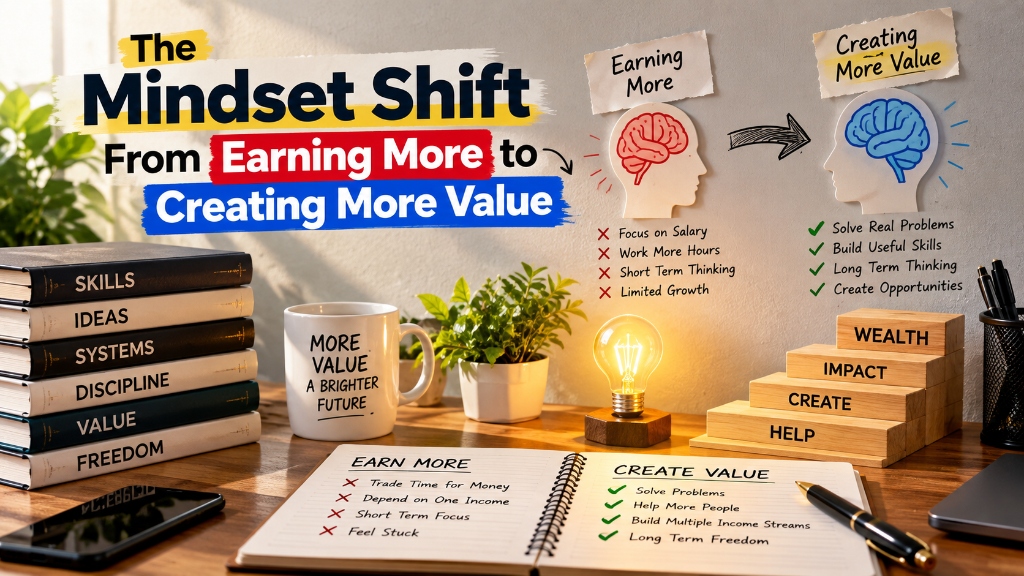
The Mindset Shift From Earning More to Creating More Value
Why focusing directly on money limits your income, and how pivoting to high-advantage value creation unlocks exponential returns.

The Power of Compounding in Business and Life
Albert Einstein called compound interest the eighth wonder of the world. Here is how compounding applies to knowledge, relationships, and career authority.

The Frugality Ceiling: Why Cutting Lattes Caps Out and How to Shift to an Earning Expansion Mindset
Discover how to break through the frugality ceiling. Overcome frugality burnout, escape scarcity thinking, and unlock uncapped income expansion.