

Navigating Tax Efficiency for High Earning Professionals
Legal asset location, tax-deferred accounts, and entity structuring strategies to preserve capital for high-earning executives and founders.
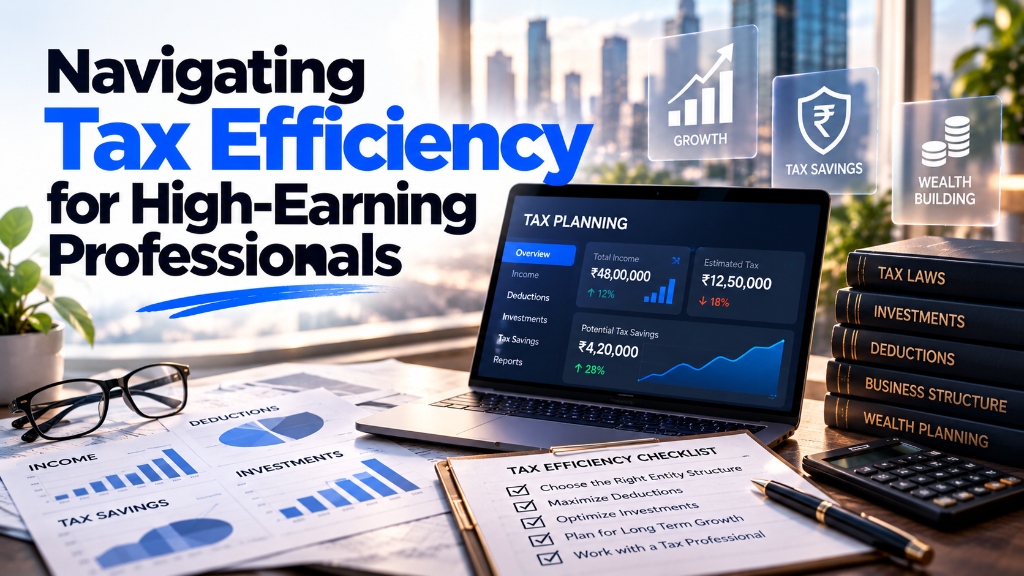
Educational Resource: This guide does not constitute financial or legal counsel.
Navigating tax efficiency requires structuring income, investments, and business entities to minimize drag under existing tax laws legally. High earners who focus solely on gross income lose up to 45% of their marginal earnings to federal, state, and local taxes, severely compromising long-term wealth compounding.
Tax efficiency is the practice of organizing financial assets to maximize after-tax net returns. High-earning professionals optimize tax drag by fully funding tax-advantaged accounts (401k, HSA, Backdoor Roth), placing tax-inefficient assets into tax-sheltered wrappers, and utilizing business entity structures like S-Corps or LLCs to deduct legitimate operational expenses.
Understanding the Difference Between Tax Avoidance and Tax Evasion
Tax efficiency relies strictly on legal tax avoidance, which uses government-created tax incentives, deductions, and wrappers to structure finances intelligently. Illegal tax evasion involves concealing income or misrepresenting expenses. Governments specifically design the tax code to encourage investments in enterprise growth, retirement security, real estate, and healthcare.
The three pillars of Advanced Tax Architecture
A comprehensive tax optimization strategy rests on three distinct foundational pillars.
1. Account Wrapper Optimization
Maximizing tax-deferred and tax-free accounts creates an immediate shelter from capital gains and dividend taxes. High earners utilize maxed 401(k) contributions, Health Savings Accounts (HSAs), and Backdoor Roth IRAs to build tax-shielded wealth.
2. Strategic Asset Location
Asset location places high-turnover, dividend-heavy, or high-yield assets inside tax-deferred retirement accounts while keeping index funds and long-term capital gains assets in taxable brokerage accounts.
3. Entity Structuring and Deductions
Operating as a business entity allows founders and consultants to pay taxes on net income after legitimate business deductions, rather than paying tax on gross earnings like standard W-2 employees.
Strategic comparison: Asset Location Matrix
| Asset Class | Income Tax Drag | Recommended Account Location | Rationale |
|---|---|---|---|
| High-Yield Real Estate REITs | High (Ordinary Income Tax Rates) | IRA / 401(k) Tax-Deferred Wrapper | Eliminates annual ordinary income tax drag |
| Dividend Paying Equities | Moderate (Qualified Dividend Rates) | Taxable Account or Roth IRA | Qualified dividends receive preferential rates |
| Low-Turnover Index Funds | Low (Capital Gains Deferred Until Sale) | Taxable Brokerage Account | High tax-efficiency + step-up basis eligibility |
| High-Frequency Trading / Options | Extreme (Short-Term Capital Gains) | Roth IRA (Tax-Free Growth) | Prevents heavy short-term capital gains tax |
How to Optimize Your Tax Architecture in 4 Steps
Implementing a tax-efficient financial system requires executing a systematic step-by-step optimization protocol.
- Max Out Triple-Tax-Advantaged HSAs: Contribute the maximum allowable amount to a Health Savings Account, invest the funds into index funds, and pay current medical bills out-of-pocket to allow tax-free compounding.
- Execute a Backdoor Roth IRA: High earners above direct Roth income limits can make non-deductible traditional IRA contributions and immediately convert them into a Roth IRA.
- Audit Asset Location Across Accounts: Move corporate bond funds and REITs into traditional IRAs, while shifting high-growth equities into Roth accounts and index funds into taxable accounts.
- Establish an LLC / S-Corp for Side Revenue: Route 1099 consulting or business income through a business entity to deduct home office, technology, professional education, and travel expenses.
Real world case example: W-2 vs Business Entity Tax Drag
Consider two professionals each generating $250,000 in gross annual income in a high-tax state:
Professional A earns $250,000 as a standard W-2 employee with zero tax planning. After federal income tax, FICA, state taxes, and standard deductions, Professional A pays roughly $82,000 in total taxes (32.8% effective tax rate), leaving $168,000 net income.
Professional B earns $250,000 operating as an S-Corporations consulting business. Professional B deducts $35,000 in legitimate business expenses (health insurance, technology, home office, professional travel), sets up a Solo 401(k) contributing $22,500, and splits remaining income between reasonable salary and distributions. Professional B pays approximately $51,000 in total taxes (20.4% effective tax rate), preserving an extra $31,000 in personal wealth every year.
Frequently asked questions
what’s the Backdoor Roth IRA strategy and is it legal?
The Backdoor Roth IRA is a legal method for high-income earners to fund a Roth IRA even if their income exceeds IRS limits. You make a non-deductible contribution to a Traditional IRA and then convert those funds to a Roth IRA. The IRS explicitly recognized this strategy under the Tax Cuts and Jobs Act.
Why is a Health Savings Account (HSA) considered triple-tax-advantaged?
An HSA offers three distinct tax benefits: contributions are 100% tax-deductible, account earnings and capital growth compound 100% tax-free, and withdrawals for qualified medical expenses are completely tax-free at any age.
How does tax-loss harvesting work in a taxable brokerage account?
Tax-loss harvesting involves selling investments that are currently operating at a loss to offset realized capital gains on winning investments. You can also use up to $3,000 in excess harvested capital losses to offset ordinary income each tax year.
Download: The 2026 Wealth Compounding & FIRE Planning Toolkit
Our complete spreadsheet model and 28-page strategic handbook covering asset allocation buckets, Indian inflation adjustments, and long-term SIP compounding.
- Interactive FIRE & Net Worth Excel/Sheets model
- Asset allocation & emergency reserve matrix
This article and its associated calculators are for educational and informational purposes only and do not constitute financial, investment, legal, tax, or medical advice. We may earn an affiliate commission on third-party links at zero cost to you. Always consult a licensed professional before making major financial, health, or investment decisions. Read our full Legal & Financial Disclaimer.
Aditya Singhania
Verified AuthorAditya writes about investing, saving habits, and smart money management. With a background in financial planning, he helps readers build simple, reliable wealth habits for the long run.
Was this essay valuable to you?
Help us refine our editorial focus and research priorities.
Reader Discussion (2)
Extremely well-articulated analysis on capital compounding. The breakdown on equity allocation vs active income is spot on.
The distinction between looking rich and building real moats is something more founders need to study deeply.
Explore Eternity Empire
Search empirical insights, explore our four wisdom categories, and discover curated strategic essays.
Search Insights
Recent Essays
The Backyard Cash Flow Engine: How to House Hack with an ADU in 2026
11 min read • Oct 20How to Become a Fractional COO: Landing Your First $5,000/Month Retainer Client
12 min read • Oct 20The Zero-Bounce Outbound Engine: How to Set Up Multi-Domain Cold Email with Instantly and Clay
12 min read • Oct 20Featured Guides
Further Wisdom & Insights
Explore All Articles
How to Manage Cash Flow in a Solo Business
A practical financial operating system for solopreneurs to smooth out uneven income cycles, automate tax reserves, and build personal wealth.

Building a Bulletproof Emergency Fund in Volatile Markets
How high earners structure liquid cash reserves across tiered yield accounts to preserve purchasing power during economic downturns.

The Asset Allocation Framework for High Earners
How high income turns into enduring wealth through structured capital allocation, risk parity, and illiquid yield reservoirs.