

The Six-Figure Paradox: Understanding Money Dysmorphia and Why High Earners Still Feel Broke
Overcome money dysmorphia signs and recovery barriers. Learn why high earners feel broke, calibrate wealth against census data, and heal financial anxiety.

Educational Resource: This guide does not constitute financial or legal counsel.
Direct Answer: Money dysmorphia is a psychological disconnect where an individual’s subjective perception of their financial insecurity fails to match their objective financial stability or high earnings. Recovery requires auditing real net worth against verified national percentiles, identifying childhood scarcity triggers, and establishing structured, guilt-free spending quotas to decouple emotional safety from bank balances.
A software architect earning $185,000 per year stands in a supermarket aisle, agonizing over whether spending an extra two dollars on organic blueberries will derail their retirement plan.
A corporate marketing director with $320,000 sitting in brokerage accounts wakes up in cold sweats at 3:00 AM, terrified that an unexpected dental procedure or water heater replacement will plunge them into bankruptcy.
These are not rare quirks of overly disciplined savers. They are classic symptoms of money dysmorphia, a cognitive distortion affecting millions of middle- and upper-income professionals. Despite earning salaries that place them comfortably in the top 10% or 5% of global earners, these individuals feel internally impoverished, perpetually vulnerable, and always one step away from financial ruin.
Money anxiety rarely resolves on its own simply because your bank balance grew by another $50,000. True financial security requires understanding the behavioral psychology behind your relationship with capital. Here is how money dysmorphia manifests, why modern technology amplifies it, and the exact calibration exercises needed to reclaim peace of mind.
What Is Money Dysmorphia? (Clinical Signs and Behavioral Symptoms)
Money dysmorphia is a recognized cognitive distortion where a person harbors an irrational, distorted view of their financial health, obsessively worrying about bankruptcy despite objective wealth.
Much like body dysmorphia distorts a person’s physical self-image in the mirror, money dysmorphia warps the psychological interpretation of bank statements and portfolio balances. No amount of accumulation ever feels like “enough” because the brain treats money as an emotional shield against trauma rather than a neutral tool for commerce.
Common clinical signs and behavioral indicators include:
- Compulsive Balance Checking: Opening banking and investment apps multiple times per day to monitor minute market fluctuations, accompanied by elevated heart rates during minor downturns.
- Physical Discomfort When Spending: Experiencing visceral guilt, stomach knots, or nausea after buying basic necessities or modest luxuries that represent less than 1% of monthly disposable income.
- Persistent Catastrophic Scenarios: Mental loops convinced that an imminent economic recession, job loss, or illness will permanently erase years of savings and force homelessness.
- Goalpost Moving Syndrome: Setting ambitious financial milestones (such as hitting $100,000 in net worth), but feeling immediate emptiness and intensifying dread the moment the goal is achieved, instantly shifting the threshold to $500,000 or $1,000,000.
- Secrecy and Shame Around Outflows: Concealing harmless personal purchases from partners or family members out of shame that one failed to maximize savings.
The Comparison Engine: How FinTech Dashboards and Social Feeds Skew Reality
Algorithmic social feeds and gamified financial technology dashboards systematically distort perceived wealth by bombarding users with extreme statistical outliers.
Before the smartphone era, your financial reference group was local: your neighbors, your colleagues at work, and your extended family. You evaluated your progress against people living in the same geographic cost-of-living reality.
Today, your brain processes curated, algorithmic streams that spotlight the top 0.01% of global consumption. A twenty-five-minute scroll through Instagram, TikTok, or YouTube presents an unending parade of twenty-four-year-olds closing seven-figure real estate transactions, flying in private airline cabins, and unboxing $15,000 luxury watches.
Your evolutionary neural circuitry does not understand that these clips represent either extreme statistical anomalies, leveraged credit illusions, or staged marketing productions. Instead, your subconscious registers a false baseline: “Everyone else is thriving effortlessly, which means my $140,000 salary is falling hopelessly behind.”
Furthermore, modern wealth dashboards (like Monarch Money, Copilot, or Empower) present your net worth as a fluctuating, real-time stock ticker. Every five-hundred-dollar dip during a standard trading week registers as an urgent threat to your subconscious, maintaining a state of perpetual physiological stress.
Hyper-Frugality vs. Pathological Scarcity Mindset: Where Is the Line?
The boundary between prudent frugality and pathological scarcity lies in whether your financial habits serve your life goals or enslave your daily emotional well-being.
Prudent frugality is intentional, joyful, and liberating. It means cutting costs ruthlessly on things you care little about (such as branded laundry detergent or luxury car leases) so you can invest aggressively and spend generously on what brings genuine fulfillment. A frugal person feels satisfied when they save money.
A pathological scarcity mindset, by contrast, is punitive, rigid, and driven by fear. It causes someone to avoid medical care, decline social dinners with cherished friends, or refuse to replace worn-out shoes that cause back pain, even when they possess thousands in liquid savings. In this state, money ceases to be a tool for living; preserving money becomes the ultimate, obsessive goal.
The Objective Reality Audit: Comparing Your Numbers to Verified Census Percentiles
An objective reality audit recalibrates your distorted internal perceptions against verified national income and wealth percentile data.
When wealth anxiety strikes, feelings cannot be reasoned with through more feelings. You must confront subjective fear with cold, empirical demographic facts.
According to United States Census Bureau and Federal Reserve Survey of Consumer Finances benchmarks:
- Household Income Realities: An individual earning $120,000 per year ranks in roughly the top 15% of all income earners nationwide. A household earning $200,000 sits comfortably within the top 8% of American households.
- Median Net Worth Baselines: The median net worth for American families under age 35 is approximately $39,000. Between ages 35 and 44, the median net worth is roughly $135,000.
- Emergency Cash Buffers: Over 40% of the population cannot cover an unexpected $1,000 emergency expense without using a credit card or borrowing from family.
If you possess a six-figure income, hold a fully funded six-month emergency cash buffer, and contribute regularly to tax-advantaged retirement accounts, you are not barely surviving. Statistically, you are operating in the upper echelon of domestic financial resilience. Reminding your rational mind of these concrete figures breaks the illusion of immediate insolvency.
Comparison Table: Prudent Frugality vs. Money Dysmorphia Patterns
| Dimension of Life | Prudent Frugal Behavior | Money Dysmorphia Behavior |
|---|---|---|
| Underlying Motivation | Freedom, intentionality, long-term goals | Deep-seated fear, panic, perceived inadequacy |
| Reaction to Necessary Spending | Calm calculation of value and utility | Physical guilt, self-chastisement, panic |
| Social Relationships | Enjoys treating friends within budget | Skips weddings, dinners, and reunions to save cash |
| Reaching Milestones | Celebrates milestones with gratitude | Experiences zero joy; immediately moves goalposts |
| Emergency Fund Perspective | Views cash reserves as peaceful insurance | Fears cash buffer is dangerously inadequate |
| View of Healthcare & Well-Being | Invests willingly in preventive health | Delays dental or medical care to avoid bills |
Somatic and Cognitive Exercises to Detach Emotional Safety from Bank Balances
Cognitive reframing and somatic grounding techniques break the subconscious association that treats bank balances as our only protection against danger.
Money anxiety is rarely about spreadsheets; it is almost always rooted in early childhood experiences: observing parents argue violently over late rent, living through a sudden family bankruptcy, or experiencing emotional instability where money became the only reliable constant.
To rewire this neural response, implement these three therapeutic practices:
1. The “Worst-Case Unpacking” Cognitive Drill
When you feel irrational panic over an expense, write down the worst-case scenario and trace it to its logical conclusion:
- “If I spend $1,200 on this necessary car repair, what happens?”
- Answer: “My checking account balance dips below $5,000.”
- Next: “What happens if it dips below $5,000?”
- Answer: “Nothing. My monthly salary arrives in twelve days, covering next month’s rent entirely.” Tracing the fear to its concrete reality demonstrates that the imagined catastrophe does not exist.
2. Somatic Grounding During Checkout
When paying for a vacation, home improvement, or dinner, notice where the tension lands in your body (tight throat, clenched jaw, contracted stomach). Pause for three deep diaphragmatic breaths, consciously drop your shoulders, and repeat this phrase: “I am safe right now. This purchase honors my hard work and does not threaten my survival.”
3. Deliberate Micro-Discomfort Training
If you struggle with extreme spending paralysis, practice spending five to ten dollars on pure, unoptimized enjoyment once per week: a gourmet pastry, fresh flowers for your desk, or high-quality coffee. Sit with the momentary discomfort without checking your banking app afterward. Over time, your nervous system learns that spending modest sums does not cause catastrophe.
Creating a Guilt-Free Spending Quota to Relearn How to Enjoy Money
A guilt-free spending quota forces chronically anxious savers to allocate a mandatory percentage of income toward pure pleasure without tracking individual line items.
Author and finance educator Ramit Sethi popularized the conscious spending framework, which categorizes finances into Fixed Costs, Long-Term Savings, Investments, and Guilt-Free Spending.
For high earners suffering from money dysmorphia, the problem is never a lack of savings discipline; it is an inability to spend without remorse. To correct this imbalance, treat your guilt-free quota not as an optional allowance, but as a mandatory spending target:
- Calculate 10% to 15% of Net Take-Home Pay: If your monthly take-home pay is $8,000 after 401(k) contributions and taxes, designate $800 to $1,200 specifically for pure enjoyment.
- Transfer to an Independent “Fun” Account: Route this sum to an entirely separate checking account with a dedicated debit card (such as a separate digital bank or credit line).
- Enforce the Use-It-Or-Lose-It Rule: Give yourself full psychological permission to spend every dollar in this account on dining out, hobbies, gifts, weekend getaways, or creative projects. Because your savings and investments were already funded at the start of the month, any penny left in this bucket has fulfilled its financial mission.
Frequently Asked Questions
Why do people making $100,000 a year feel broke?
People making $100,000 feel broke due to a combination of high coastal housing costs, student loan repayments, child care expenses, lifestyle creep, and algorithmic comparison engines that make six-figure salaries feel average when compared to internet extremes.
Can therapy help with money dysmorphia?
Yes, certified Financial Therapists (accredited through the Financial Therapy Association) and licensed mental health counselors use Cognitive Behavioral Therapy (CBT) and Internal Family Systems (IFS) to help clients uncover subconscious childhood money scripts and alleviate wealth anxiety.
Is money dysmorphia an officially recognized medical disorder?
Money dysmorphia is not an independent diagnosis in the DSM-5, but psychologists and financial planners recognize it as an acute manifestation of Generalized Anxiety Disorder (GAD) and Obsessive-Compulsive tendencies centered around financial security.
How do I talk to my spouse about their money anxiety?
Approach your spouse with empathy rather than criticism by focusing on how early life experiences shaped their views on money. Review shared goals together using objective balance sheets, and establish agreed-upon personal spending thresholds below which neither partner needs to ask permission.
How does money dysmorphia affect retirement planning?
Money dysmorphia causes individuals to suffer from “One More Year Syndrome,” endlessly delaying retirement or work downshifting despite having accumulated multi-million-dollar portfolios that easily support safe withdrawal rates.
Final Thoughts: True Wealth Is Freedom from Fear
Accumulating millions in liquid investments is pointless if your nervous system remains trapped in perpetual scarcity.
Money is simply stored energy designed to give you agency, security, and the freedom to spend meaningful time with people you love. When you break free from the comparison engine, audit your position against verified reality, and give yourself permission to enjoy what you have built, money ceases to be a source of terror and returns to its rightful role as your servant.
Take your first recovery step today: audit your real net worth against census data, set up a dedicated guilt-free spending bucket, and celebrate the milestones you worked so hard to achieve.
Download: The 20 Mental Models Strategic Decision Matrix
A tactical guide to second-order thinking, probabilistic forecasting, and maintaining stoic composure under high-stakes market pressure.
- First-principles problem breakdown worksheets
- Cognitive bias detection & risk checklist
This article and its associated calculators are for educational and informational purposes only and do not constitute financial, investment, legal, tax, or medical advice. We may earn an affiliate commission on third-party links at zero cost to you. Always consult a licensed professional before making major financial, health, or investment decisions. Read our full Legal & Financial Disclaimer.
Rohan Kulkarni
Verified AuthorRohan writes about decision-making, mental clarity, and money psychology. He focuses on how our daily thinking patterns and emotions influence our financial and life choices.
Was this essay valuable to you?
Help us refine our editorial focus and research priorities.
Reader Discussion (2)
Extremely well-articulated analysis on capital compounding. The breakdown on equity allocation vs active income is spot on.
The distinction between looking rich and building real moats is something more founders need to study deeply.
Explore Eternity Empire
Search empirical insights, explore our four wisdom categories, and discover curated strategic essays.
Search Insights
Recent Essays
The Backyard Cash Flow Engine: How to House Hack with an ADU in 2026
11 min read • Oct 20How to Become a Fractional COO: Landing Your First $5,000/Month Retainer Client
12 min read • Oct 20The Zero-Bounce Outbound Engine: How to Set Up Multi-Domain Cold Email with Instantly and Clay
12 min read • Oct 20Featured Guides
Further Wisdom & Insights
Explore All Articles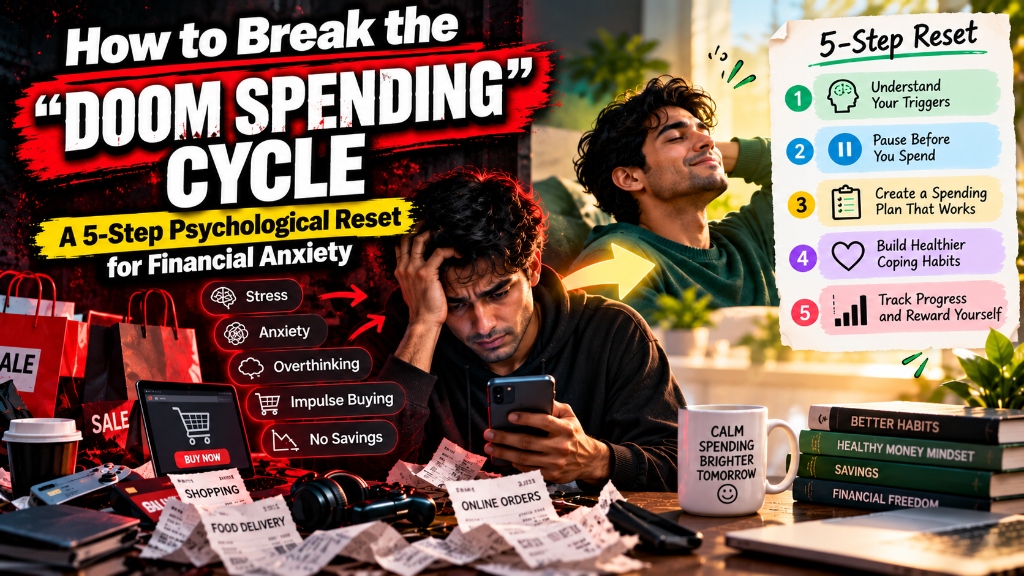
How to Stop Doom Spending: A 5-Step Reset for Financial Anxiety
Learn how to stop doom spending when economic anxiety hits. Master the 72-hour friction rule, emotional trigger resets, and loud budgeting habits.

The Psychology of Long-Term Thinking in a Distracted World
How high performers resist short-term dopamine loops, optimize for second-order consequences, and build compound advantages over 10-year horizons.

How to Overcome Imposter Syndrome in High Stakes Roles
How executives and founders reframe internal self-doubt, build objective evidence logs, and master high-responsibility positions.