

Building Pricing Power: How to Charge Premium Rates
How high-margin businesses construct pricing power, shift from hourly billing to value pricing, and double profitability.

Educational Resource: This guide does not constitute financial or legal counsel.
Building pricing power is the ability to increase rates significantly without losing customer volume or market share. Companies with true pricing power anchor rates to the financial value delivered to buyers rather than calculating internal hourly costs or undercutting low-cost market competitors.
Pricing power measures a company’s capacity to raise prices without experiencing demand collapse. Establish premium pricing by shifting from hourly billing to value-based project pricing, targeting enterprise buyers with high financial stakes, packaging services into clear transformation tiers, and introducing scarcity barriers.
The flaw of Cost-Plus and Hourly Billing
Charging for time incentivizes internal inefficiency. When a consultant or agency bills $150 per hour, solving a client’s problem in two hours earns $300, whereas dragging out the work for 20 hours yields $3,000. Hourly pricing punishes expertise and speed while forcing clients to view services as a commoditized expense line item.
| Pricing Model | Operational Reality | Financial Outcome |
|---|---|---|
| Hourly Cost Billing | Punishes speed, experience, and workflow efficiency | Commodity trap with strictly capped earnings |
| Value-Based Pricing | Rewards outcome velocity and measurable client ROI | Premium margins and scalable business leverage |
The three anchors of Value-Based Pricing
Value-based pricing sets fees as a percentage of the measurable economic outcome your service generates for the buyer.
1. Revenue Expansion Anchor
If your marketing campaign or sales funnel overhaul reliably generates $500,000 in net new sales for a client, charging a fixed fee of $50,000 represents a 10x ROI for the client while capturing high profit margins.
2. Cost Reduction Anchor
If your enterprise software integration eliminates $200,000 in redundant manual contractor billing annually, a $40,000 implementation price tag delivers immediate payback within three months.
3. Strategic Risk Mitigation Anchor
If your technical audit prevents data breaches that carry average regulatory fines of $2,000,000, charging $25,000 for a security audit is an easy corporate risk management decision.
Strategic comparison: Pricing Strategies
| Pricing Model | Client Perception | Margin Potential | Scalability | Price Resistance |
|---|---|---|---|---|
| Hourly Rate Billing | Expense Line Item | Low (Capped by Hours) | Poor | High (Every hour questioned) |
| Cost-Plus Margin | Commodity Commodity | Moderate (Fixed 20%-30%) | Low | Moderate |
| Fixed Scope Retainer | Predictable Budget | Good (If efficient) | Moderate | Low |
| Value-Based Pricing | Investments with ROI | Maximum (80%+ Margins) | High | Minimal (When ROI is clear) |
How to Execute a 50% Price Increase in 4 Steps
Raising prices on existing services requires systematic positioning and positioning upgrades.
- Calculate the Economic Impact: Document explicit metrics from past successful clients (e.g., hours saved, additional leads, costs cut).
- Reframe Offer Packages into 3 Tiers: Present three options: Standard, Accelerated (Recommended), and Enterprise VIP. Make the middle tier your primary target.
- Qualify Buyers by Financial Stakes: Shift marketing outreach toward clients with over $5M in annual revenue, where small percentage improvements translate into massive dollar returns.
- Grandfather Existing Clients with a Deadline: Give current clients 60 days of advance notice before rate increases take effect, offering them a chance to lock in current rates with a annual commitment.
Real world case example: Consulting Agency Pivot
Consider a specialized cybersecurity consultancy charging $175/hour to perform vulnerability scans for mid-sized logistics companies. Average project revenue hovered at $7,000 per client across 40 hours of labor.
The consultancy shifts to value-based fixed pricing. They reposition the offering as: “Logistics Ransomware Immunity Shield: Full Compliance Audit & Incident Prevention”.
Instead of billing hourly, they charge a flat $28,000 project fee. Because their internal automation scripts allow them to complete the audit in 15 hours, their effective hourly rate increases from $175 to $1,866, while clients enthusiastically pay for the clear outcome and risk guarantee.
Frequently asked questions
what’s the best way to handle price objections during sales calls?
When a prospect objects to price, steer the conversation back to outcome metrics rather than cost breakdowns. Ask: “If this implementation generates the target $200,000 in new sales we discussed, is investing $20,000 to achieve that outcome acceptable?”
How do I know if I have room to raise my prices?
If your sales close rate is above 75%, your prices are almost certainly too low. An optimal closing rate for premium-priced services is between 30% and 50%, indicating that your offer tests the upper threshold of market value.
Can saaS companies utilize value-based pricing?
Yes, SaaS companies utilize value-based pricing through value metric scaling, such as charging per active user, per tracked contact, or per processed monthly transaction volume rather than flat account tiers.
Download: The Solo Founder's High-Margin Scaling Playbook
A battle-tested blueprint on building asymmetric leverage, packaging high-ticket B2B services, and converting labor into scalable digital products.
- Pricing power & contract negotiation scripts
- Micro-SaaS & digital product launch checklist
This article and its associated calculators are for educational and informational purposes only and do not constitute financial, investment, legal, tax, or medical advice. We may earn an affiliate commission on third-party links at zero cost to you. Always consult a licensed professional before making major financial, health, or investment decisions. Read our full Legal & Financial Disclaimer.
Vikram Nair
Verified AuthorVikram covers small business ideas, digital ventures, and practical company growth. Having worked alongside early-stage founders, he writes straightforward advice on building profitable businesses.
Was this essay valuable to you?
Help us refine our editorial focus and research priorities.
Reader Discussion (2)
Extremely well-articulated analysis on capital compounding. The breakdown on equity allocation vs active income is spot on.
The distinction between looking rich and building real moats is something more founders need to study deeply.
Explore Eternity Empire
Search empirical insights, explore our four wisdom categories, and discover curated strategic essays.
Search Insights
Recent Essays
The Backyard Cash Flow Engine: How to House Hack with an ADU in 2026
11 min read • Oct 20How to Become a Fractional COO: Landing Your First $5,000/Month Retainer Client
12 min read • Oct 20The Zero-Bounce Outbound Engine: How to Set Up Multi-Domain Cold Email with Instantly and Clay
12 min read • Oct 20Featured Guides
Further Wisdom & Insights
Explore All Articles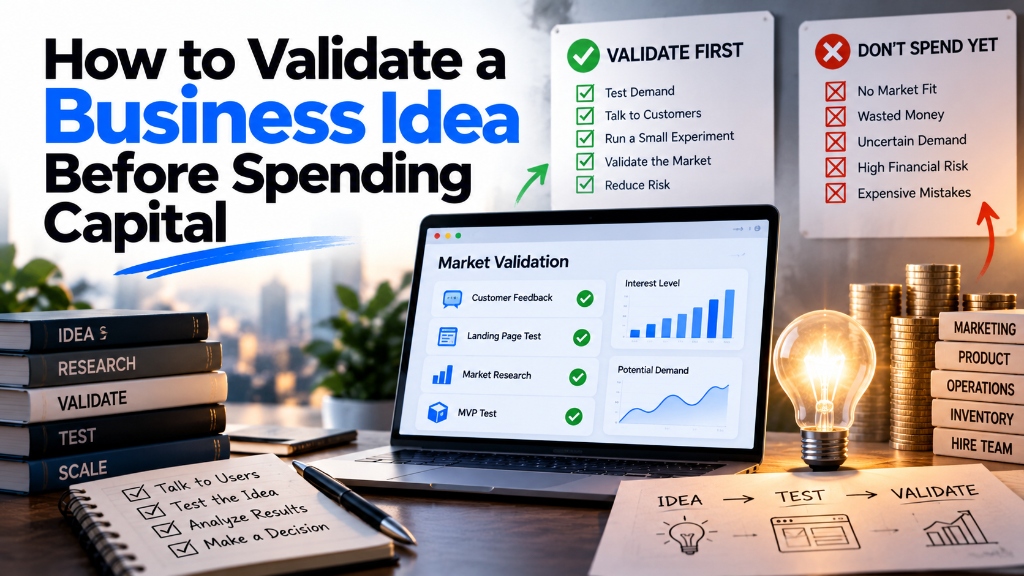
How to Validate a Business Idea Before Spending Capital
A step-by-step validation framework for testing market demand, collecting presales, and confirming buyer willingness to pay.

Engineering High Converting Value Proposition Messaging
How to craft clear, customer-centric value propositions that eliminate buyer friction and increase landing page conversion rates.

Building Asymmetric Leverage in Modern Business
Why modern enterprises scale through code, capital, media, and zero-marginal-cost distribution mechanisms.