

Apple Pay India Launch: How to Set It Up, Where It Works, and What's Missing (2026)
Apple Pay is now live in India with Axis Bank. See how to set it up, which cards work, where to use it, and why UPI is not included yet.
Educational Resource: This guide does not constitute financial or legal counsel.
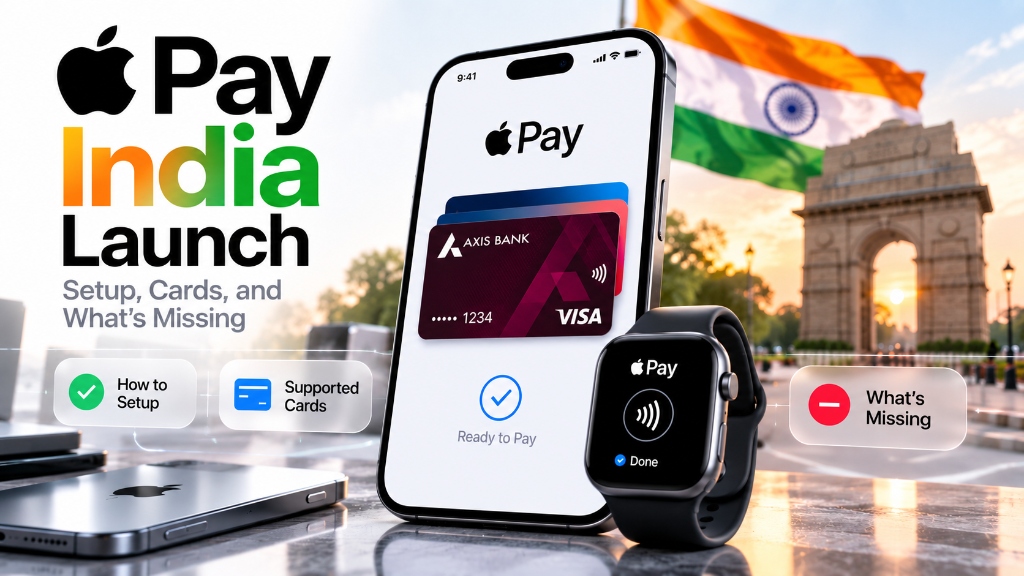
Apple Pay launched in India on 30 September 2026, featuring Axis Bank as its exclusive initial banking partner. Eligible Visa and Mastercard credit cardholders can pay securely via NFC using iPhone, iPad, and Apple Watch. However, debit cards, RuPay networks, and UPI integration remain unsupported at launch.
After years of anticipation, Apple Pay is officially live in India.
The rollout began on 30 September 2026, with Axis Bank serving as the exclusive inaugural banking partner. If you carry an iPhone and an eligible Axis Bank credit card, you can activate mobile tap-to-pay functionality today.
However, key features are restricted during initial availability. Debit cards and major banking competitors are absent, while native UPI support is not included. Here is an exhaustive breakdown of how Apple Pay operates in India, how to configure your account, and where the service fits alongside existing payment networks.
Is Apple Pay Available in India Now?
Yes, Apple Pay officially became available in India on 30 September 2026.
The service runs natively across iOS, iPadOS, and watchOS devices. macOS support for Safari checkout is scheduled to arrive in a subsequent software update.
The initial deployment follows a staged strategy. Only Axis Bank credit cards are compatible at launch, meaning cardholders from other major financial institutions must wait for expanded banking partnerships.
| Apple Pay India Launch Feature | Initial Rollout Status |
|---|---|
| Launch Date | 30 September 2026 |
| Launch Banking Partner | Axis Bank |
| Supported Card Types | Axis Bank Credit Cards (Visa & Mastercard) |
| Supported Devices | iPhone, iPad, Apple Watch (Mac coming soon) |
| Unsupported at Launch | Debit Cards, RuPay Cards, UPI, Other Banks |
Axis Bank stands as India’s third-largest private lender and fourth-largest credit card issuer, managing approximately 16.3 million active credit cards as of August 2026.
What Is Apple Pay and How Does It Work?
Apple Pay is a contactless mobile payment service that enables secure transactions using your Apple device instead of a physical payment card.
The technology relies on Near Field Communication (NFC), the standard short-range wireless protocol used by contactless point-of-sale (POS) terminals. Holding your device near an enabled payment reader triggers an encrypted transaction verification.
To protect consumer privacy, your real 16-digit card number is never transmitted or stored on merchant servers. Apple Pay utilizes tokenization, generating a unique Device Account Number for each transaction.
Physical cards remain safely at home, managed entirely within the preinstalled Apple Wallet application.
Which Cards Work With Apple Pay in India?
Only Axis Bank credit cards issued on the Visa and Mastercard networks are supported at launch.
Consequently, several popular card categories are excluded from the initial launch phase:
- Debit Cards: Unsupported at launch across all banking networks.
- RuPay Network: Cards issued on the domestic RuPay network are currently not compatible.
- Other Major Banks: HDFC Bank, ICICI Bank, and SBI Card are not included at launch. Ongoing discussions regarding commercial terms and revenue sharing are reportedly underway.
Cardholders with primary accounts at non-partner banks will gain access as additional institutions finalize commercial agreements with Apple.
How to Set Up Apple Pay in India
Setting up Apple Pay in India takes only a few minutes using either the native Apple Wallet app or the Axis Bank mobile banking app.
Option 1: Add Card via Apple Wallet
- Open the Wallet app on your iPhone.
- Tap the + icon in the upper right corner.
- Select Debit or Credit Card.
- Frame your Axis Bank credit card within the camera viewer, or input details manually.
- Review and accept the terms and conditions.
- Enter the one-time verification code (OTP) sent to your registered mobile number.
- Confirm approval and set your card as the default payment option.
Option 2: Add Card via Axis Bank Mobile App
- Launch and authenticate into the Axis Bank Mobile App.
- Navigate to your eligible credit card dashboard.
- Tap the Add to Apple Wallet action button.
- Follow the onscreen prompt to pass bank authentication.
- Complete setup directly within the iOS Wallet application.
No secondary third-party software is required. Apple Wallet handles all card storage and biometric authentication natively.
How to Pay With Apple Pay
To pay in physical retail stores, double-click the side button on your iPhone, authenticate using Face ID or Touch ID, and hold the top of your device near the contactless terminal screen.
For in-app purchases and Safari web checkouts, select Apple Pay during payment selection and authorize the transaction instantly via Face ID or Touch ID without manually entering card details.
Where Can You Use Apple Pay in India?
Apple Pay functions at any merchant location across India equipped with an NFC-enabled contactless POS card terminal.
Acceptance covers three primary channels:
- Retail Outlets & Restaurants: Any merchant displaying the contactless payment symbol or Apple Pay logo on their card terminal.
- Mobile Applications: In-app checkouts for e-commerce platforms that integrate the Apple Pay SDK.
- Safari E-Commerce Sites: Websites accepting online card payments through Safari web browsers.
Certain smaller merchants and regional retailers in India operate older non-NFC card machines. Verifying contactless support before tapping ensures a smooth transaction.
Apple Pay vs UPI and Google Pay in India
Apple Pay and Unified Payments Interface (UPI) operate on fundamentally different financial rails.
Apple Pay processes credit card transactions over global card networks (Visa/Mastercard). UPI facilitates instant, direct bank-to-bank account transfers without credit card infrastructure.
According to International Monetary Fund (IMF) data, UPI handles 84% of digital payment volumes in India due to zero merchant discount rates (MDR) on basic transactions and widespread QR code adoption.
Apple Pay does not feature UPI integration at launch, meaning users cannot scan merchant UPI QR codes or send peer-to-peer bank transfers through Apple Wallet.
| Feature Comparison | Apple Pay | UPI (Google Pay, PhonePe, Paytm) |
|---|---|---|
| Payment Backbone | Credit Card Networks (Visa/Mastercard) | Direct Bank-to-Bank Rails |
| Merchant Acceptance | NFC Contactless POS Terminals | Universal QR Codes & Mobile Numbers |
| Card Reward Points | Full Reward Point Accumulation | Standard Bank Transfers (Limited Rewards) |
| Biometric Security | Hardware-Level Tokenization & Face ID | 4/6-Digit UPI PIN |
| Peer-to-Peer Transfers | Not Supported in India | Instant Free Peer-to-Peer |
Apple Pay serves high-income users seeking card reward optimization, hardware tokenization, and swift online checkout. UPI remains the primary channel for micro-merchants and peer-to-peer transfers.
Is Apple Pay Safe to Use in India?
Yes, Apple Pay is highly secure and engineered with strict hardware-level data isolation.
- Device Account Number (Tokenization): Actual credit card numbers are never stored on your iPhone or shared with merchants.
- Biometric Authentication: Every transaction requires explicit Face ID, Touch ID, or passcode confirmation.
- Find My Integration: If an iPhone is lost or stolen, users can remotely suspend card tokens via iCloud without canceling physical credit cards.
Financial data is encrypted inside a dedicated Secure Element chip on your Apple hardware, preventing data interception.
What Is Next for Apple Pay in India?
The initial deployment with Axis Bank marks the opening phase of Apple’s payments expansion in India.
Industry reports indicate negotiations with major issuers like HDFC Bank and ICICI Bank are active, with commercial terms remaining the primary milestone before broader rollout.
Key future developments to track include:
- Onboarding major private and public sector banks.
- Support for debit cards and domestic RuPay credit card integration.
- Safari web checkout support for macOS.
- Potential regulatory alignment for local UPI interoperability.
Frequently Asked Questions
When did Apple Pay launch in India?
Apple Pay launched in India on 30 September 2026.
Which bank supports Apple Pay in India?
Axis Bank is the initial launch partner supporting eligible credit cards.
Can I use a debit card with Apple Pay in India?
No, debit cards are not supported at launch; only credit cards are active.
Does Apple Pay support RuPay cards?
No, RuPay network cards are currently not supported at launch.
Does Apple Pay support UPI in India?
No, Apple Pay operates strictly on credit card rails and does not integrate UPI QR codes at launch.
Which devices support Apple Pay in India?
iPhone, iPad, and Apple Watch support Apple Pay, with Mac support coming soon.
Will HDFC, ICICI, or SBI Card support Apple Pay?
Not at initial launch, though commercial discussions with major banks remain ongoing.
Do I need a separate app to use Apple Pay?
No, Apple Pay is built directly into the iOS Wallet application.
Is Apple Pay better than Google Pay in India?
They serve different purposes; Google Pay focuses on UPI bank transfers, while Apple Pay streamlines contactless credit card payments.
Are there transaction limits on Apple Pay?
Transaction limits correspond directly to your Axis Bank credit card credit limit and RBI contactless guidelines.
Do I need Face ID or Touch ID for every transaction?
Yes, every payment requires biometric authorization or passcode entry for security.
Where can I use Apple Pay in India?
At any store with an NFC contactless POS terminal, in supported iOS apps, and on Safari web checkouts.
Final Thoughts
Apple Pay’s arrival in India provides iPhone users with a secure, hardware-tokenized alternative for contactless credit card payments.
For eligible Axis Bank cardholders, setup takes under two minutes within Apple Wallet. Cardholders with other major financial institutions will benefit as additional banks complete integration terms over the coming months.
Download: The 2026 Wealth Compounding & FIRE Planning Toolkit
Our complete spreadsheet model and 28-page strategic handbook covering asset allocation buckets, Indian inflation adjustments, and long-term SIP compounding.
- Interactive FIRE & Net Worth Excel/Sheets model
- Asset allocation & emergency reserve matrix
This article and its associated calculators are for educational and informational purposes only and do not constitute financial, investment, legal, tax, or medical advice. We may earn an affiliate commission on third-party links at zero cost to you. Always consult a licensed professional before making major financial, health, or investment decisions. Read our full Legal & Financial Disclaimer.
Aditya Singhania
Verified AuthorAditya writes about investing, saving habits, and smart money management. With a background in financial planning, he helps readers build simple, reliable wealth habits for the long run.
Was this essay valuable to you?
Help us refine our editorial focus and research priorities.
Reader Discussion (2)
Extremely well-articulated analysis on capital compounding. The breakdown on equity allocation vs active income is spot on.
The distinction between looking rich and building real moats is something more founders need to study deeply.
Explore Eternity Empire
Search empirical insights, explore our four wisdom categories, and discover curated strategic essays.
Search Insights
Recent Essays
The Backyard Cash Flow Engine: How to House Hack with an ADU in 2026
11 min read • Oct 20How to Become a Fractional COO: Landing Your First $5,000/Month Retainer Client
12 min read • Oct 20The Zero-Bounce Outbound Engine: How to Set Up Multi-Domain Cold Email with Instantly and Clay
12 min read • Oct 20Featured Guides
Further Wisdom & Insights
Explore All Articles
High-Interest Savings Accounts vs Fixed Deposits in India: Where Should You Keep Your Money?
Compare high-interest savings accounts vs fixed deposits in India for 2026. Review interest rates, DICGC insurance, tax rules, and emergency fund strategies.

AI Money Management Tools: Can AI Help You Budget, Save and Invest Smarter?
Discover the best AI personal finance tools in 2026. Compare AI expense tracking, automated savings, spreadsheet assistants, privacy risks, and real limitations.

Best Investment Apps in India for Beginners (2026): Compare Features and Fees
Compare the best investment apps in India for beginners in 2026. Review Zerodha, Groww, Angel One, Dhan, and INDmoney on fees, features, and ease of use.